

The UBER Exit: Inside The FAAN Airport War and Nigeria’s Regulatory Crisis
By Arit Mbeh
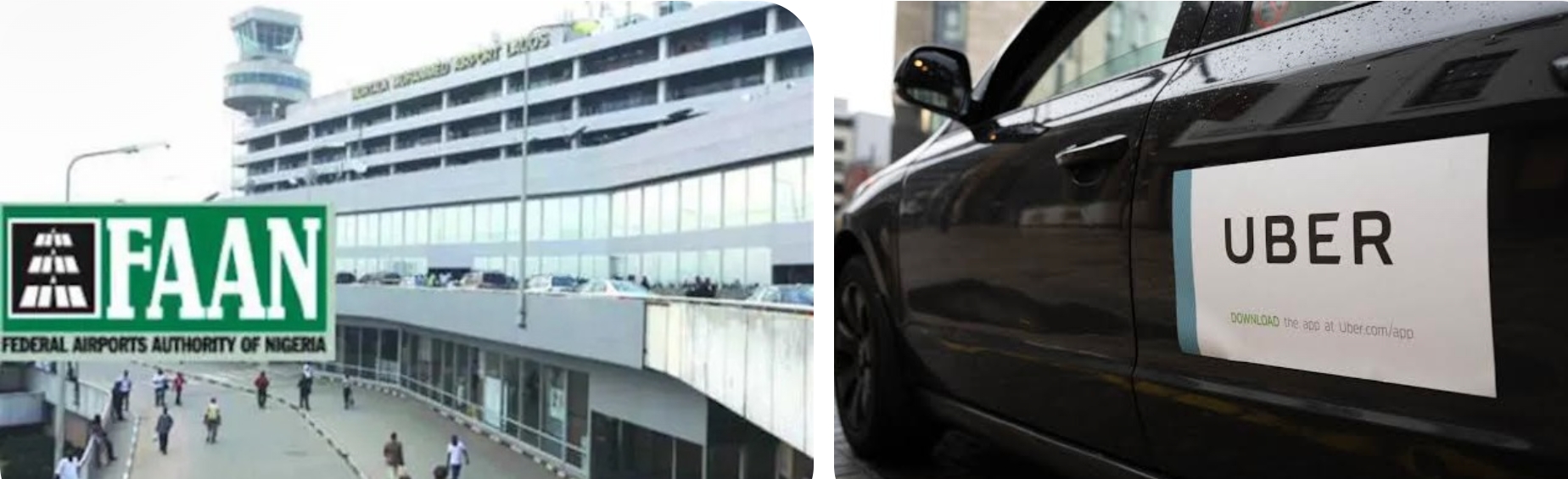
Uber’s decision to leave Nigeria after 12 years came days after a bitter dispute over airport operations involving the Federal Airports Authority of Nigeria, FAAN. The company says the airport controversy did not cause its exit. But the episode exposed the regulatory friction, rising costs and institutional tensions that have made Nigeria’s mobility market increasingly difficult to navigate.
For 12 years, Uber was one of the most visible symbols of Nigeria’s digital transformation. Its arrival in Lagos in 2014 altered the economics and culture of urban transportation. Instead of negotiating with a taxi driver on the roadside, passengers could summon a vehicle through a smartphone, see the driver’s identity, track the journey and receive an estimated fare before entering the car. The model spread rapidly, eventually becoming a familiar part of transportation in Abuja and other Nigerian cities. Thousands of drivers relied on the platform for income, while millions of passengers embraced its convenience. Uber also disrupted a traditional taxi industry that had operated for decades with little technological interference.
That disruption eventually reached one of the most tightly controlled spaces in Nigeria’s transportation sector: the airports.
On July 30, FAAN directed managers of airports under its control to suspend the commercial operations of Uber and Bolt pending the conclusion and execution of licence agreements with the companies. The directive exposed a fault line between two competing transportation systems: one built around physical taxi ranks, designated operators and direct airport supervision; the other built around digital platforms connecting passengers and independent drivers without requiring them to operate from conventional taxi ranks.
For passengers, the consequences were immediate. At Murtala Muhammed International Airport in Lagos and Nnamdi Azikiwe International Airport in Abuja, e-hailing had become a preferred option for travellers seeking predictable prices, identifiable drivers and convenient pick-up arrangements. The suspension disrupted that routine, while complaints emerged over the cost of alternative airport transportation. One widely reported complaint involved a passenger who said a journey from Lagos airport to Ikeja that had previously cost approximately N8,000 through an e-hailing service attracted a reported airport taxi quotation of N30,000.
Individual fare reports cannot establish the general pricing structure of airport transportation, but they became politically significant because they reinforced a widespread perception that restricting e-hailing competition would increase costs for passengers. The controversy consequently moved beyond licensing and airport management into the territory of consumer protection and competition.
FAAN rejected the suggestion that it had banned Uber and Bolt or sought to create a monopoly for airport taxi operators. The Authority argued that airports are highly regulated security environments and that commercial transport operators must be identifiable, monitored and accountable. It also defended its Airport Car Hire Rank Management System, ACHRAMS, describing it as a mechanism for managing airport car-hire operations, improving visibility over vehicles and drivers, and strengthening accountability rather than as an alternative to e-hailing platforms.
There is a legitimate regulatory basis for FAAN’s position. Airports cannot reasonably permit unidentified vehicles and drivers to operate without oversight inside sensitive aviation facilities. The more difficult issue is how those requirements are implemented. FAAN’s July directive required the suspension of Uber and Bolt operations pending licensing arrangements, while subsequent public statements stressed that e-hailing services had not been banned. For passengers, the distinction was largely academic: access had been disrupted.
That gap between regulatory language and consumer experience became central to the controversy. The airport dispute was no longer simply about whether FAAN had the authority to regulate commercial vehicles. It was about whether the regulatory framework could accommodate digital transportation without undermining competition and passenger convenience.
ACHRAMS became a particular focus of scrutiny. FAAN maintained that the system was designed to manage airport car-hire operations rather than compete commercially with Uber or Bolt. Nevertheless, the arrangement raised questions about market access. When an airport restricts one category of transportation provider while traditional airport operators retain established physical access to passengers, the environment can appear commercially uneven even if the stated objective is security and accountability. At airports, where passengers have limited transportation choices once they leave the terminal, access itself has significant commercial value.
The controversy eventually reached Aviation Minister Festus Keyamo. Following complaints over the disruption and reported increases in airport transportation fares, the minister directed FAAN to address the situation. Bolt subsequently resumed operations at FAAN-managed airports after reaching an operational arrangement with the Authority, and FAAN reiterated that its objective was to establish a framework that would allow e-hailing companies to operate while meeting airport security and accountability requirements.
The immediate conflict with Bolt was therefore eased. Uber, however, was about to leave Nigeria altogether.
On September 2, Uber announced that it was winding down its Nigerian operations after 12 years. The timing made the airport dispute impossible to ignore, and speculation quickly emerged that the FAAN confrontation had become the final straw. But timing alone cannot establish causation. Uber has said the FAAN directive was unrelated to its decision and attributed its departure to a review of its evolving business priorities and investment focus across Africa.
The company’s broader corporate strategy supports that explanation. Uber has been restructuring its global operations, cutting jobs and seeking to concentrate resources on areas with stronger long-term growth prospects, including emerging transportation technologies. Its withdrawal from Nigeria was therefore part of a broader corporate calculation rather than an isolated response to the FAAN dispute.
Nigeria’s own economic environment also provides substantial reasons for a company to reassess its investment. The ride-hailing industry operates under intense cost pressure as fuel prices, vehicle maintenance costs and inflation have increased, while currency volatility complicates financial planning and competition has intensified.
For drivers, the economics can be punishing. They carry the cost of fuel, repairs, insurance and other expenses while trying to remain competitive enough to attract passengers. Platforms face the opposite pressure: passengers want affordable fares while drivers want higher earnings, leaving companies to balance customer demand against the cost of maintaining an adequate supply of vehicles. If fares rise too sharply, passengers reduce usage; if driver earnings fall, vehicle supply declines. Either outcome puts pressure on the platform.
The airport dispute introduced another layer of uncertainty. Airport journeys are commercially important because they tend to be longer and because passengers often place a premium on reliability. E-hailing platforms also benefit from digital booking, driver identification and electronic trip records. Restrictions on airport operations can therefore affect customer experience, driver utilisation and the platform’s competitive position even if airports account for only part of total business.
This does not make FAAN responsible for Uber’s departure. It does demonstrate why airport access forms part of the commercial equation for any ride-hailing company operating in Nigeria.
The larger issue is regulatory predictability. Global companies can accommodate regulation when rules are clear, consistent and capable of being priced into business plans. Licence fees, taxes and compliance requirements are normal costs of operating in regulated markets. Greater difficulty arises when requirements are unclear, enforcement changes abruptly or different agencies impose overlapping expectations.
The FAAN controversy illustrated that problem. The Authority had legitimate concerns about airport security and accountability. E-hailing companies had legitimate operational requirements. Traditional airport taxi operators had legitimate concerns about competition. Passengers had a legitimate expectation of convenient and affordable transportation. The failure was not necessarily that one interest was illegitimate; it was that the interests were not aligned before the dispute disrupted the market.
Nigeria’s wider regulatory structure compounds the problem. Digital businesses frequently operate across several regulatory categories simultaneously. A ride-hailing company can be a technology platform, transportation intermediary, corporate taxpayer and, when its vehicles operate within an airport, a participant in a highly regulated aviation environment. Without effective coordination, businesses can face overlapping requirements and inconsistent expectations.
The cost is eventually distributed across the market. Companies absorb compliance expenses, drivers absorb operating costs, passengers absorb higher fares, and government bears the economic consequences when investment becomes less attractive.
Uber’s departure must therefore be examined within that wider context. The company says FAAN was not responsible for its exit, and that statement should be taken seriously. But the airport controversy remains significant because it exposed the type of institutional friction that can make a difficult market more challenging.
It also demonstrated the consequences of regulatory intervention without a sufficiently smooth transition. A more coordinated approach could have allowed FAAN to establish its requirements while maintaining uninterrupted access to e-hailing services. The fact that ministerial intervention became necessary suggests that the regulatory process was not functioning as smoothly as it should.
The consequences now extend beyond Uber. Bolt and other operators remain in Nigeria, while local mobility companies continue to compete for passengers and drivers. Uber’s departure creates an opportunity for rivals to capture its former market share, but it also reduces the number of major international operators competing for Nigerian consumers. Competition matters because it constrains prices and encourages better service; a market with fewer significant players can eventually provide less choice even when the remaining companies initially compete aggressively.
That makes the regulatory treatment of the remaining platforms particularly important. The objective should not be to protect one company from another but to protect competition itself.
FAAN’s responsibility to regulate airports is clear, as is government’s responsibility to protect passengers. The challenge is ensuring that security requirements do not become unnecessary barriers to competition. Nigeria’s ambition to become a leading digital economy requires institutions capable of adapting regulation to technological change rather than forcing new business models into frameworks designed for an analogue economy.
Uber’s 12-year Nigerian journey demonstrates both the opportunity and vulnerability of the market. The company proved that Nigerians were willing to embrace technology when it delivered tangible benefits and helped transform transportation culture. Its departure demonstrates that successful market penetration does not guarantee long-term commitment. Businesses ultimately follow the economics of their operations and the prospects for future returns.
The wrong response would be to search for a single culprit. FAAN cannot fairly be blamed for Uber’s departure without evidence, while Uber’s withdrawal cannot be understood without considering the difficult economic conditions in which it operated. The more useful approach is to examine the entire ecosystem: the cost of running a ride-hailing platform, the regulatory burden, airport access arrangements, competition, driver economics and the effect of these factors on consumers.
The government should now use the controversy to review the regulatory framework for digital mobility, particularly licensing arrangements, airport transportation, e-hailing access, applicable fees and coordination between aviation and transportation authorities. The objective should be evidence-based reform rather than blame.
There is no evidence that FAAN directly forced Uber out of Nigeria. There is, however, ample reason to examine whether regulatory complexity contributes to the broader cost and uncertainty facing mobility companies.
That distinction matters. Blaming FAAN for Uber’s departure would oversimplify a complex corporate decision. Ignoring the FAAN controversy would be equally simplistic because the episode revealed how quickly a licensing disagreement can affect passengers, drivers, operators and public confidence.
Uber came to Nigeria in 2014 and changed how Nigerians moved around their cities. Twelve years later, it has left. The company’s departure closes one chapter in Nigeria’s ride-hailing story, but the FAAN controversy has opened a more consequential one—about whether Nigeria can regulate innovation without weakening competition, raising costs or discouraging investment.
The cost of getting that balance wrong will not be measured only by the number of companies that leave. It will appear in higher prices, fewer choices, lost investment and reduced opportunities for workers.
Uber’s exit is therefore not the end of the story. It is a warning that Nigeria’s regulatory institutions must evolve at the same speed as the businesses they seek to regulate.