
23 Vehicles and the Question of Public Trust: Ortom’s Defence Raises More Questions Than Answers
Ortom
By Our Correspondent
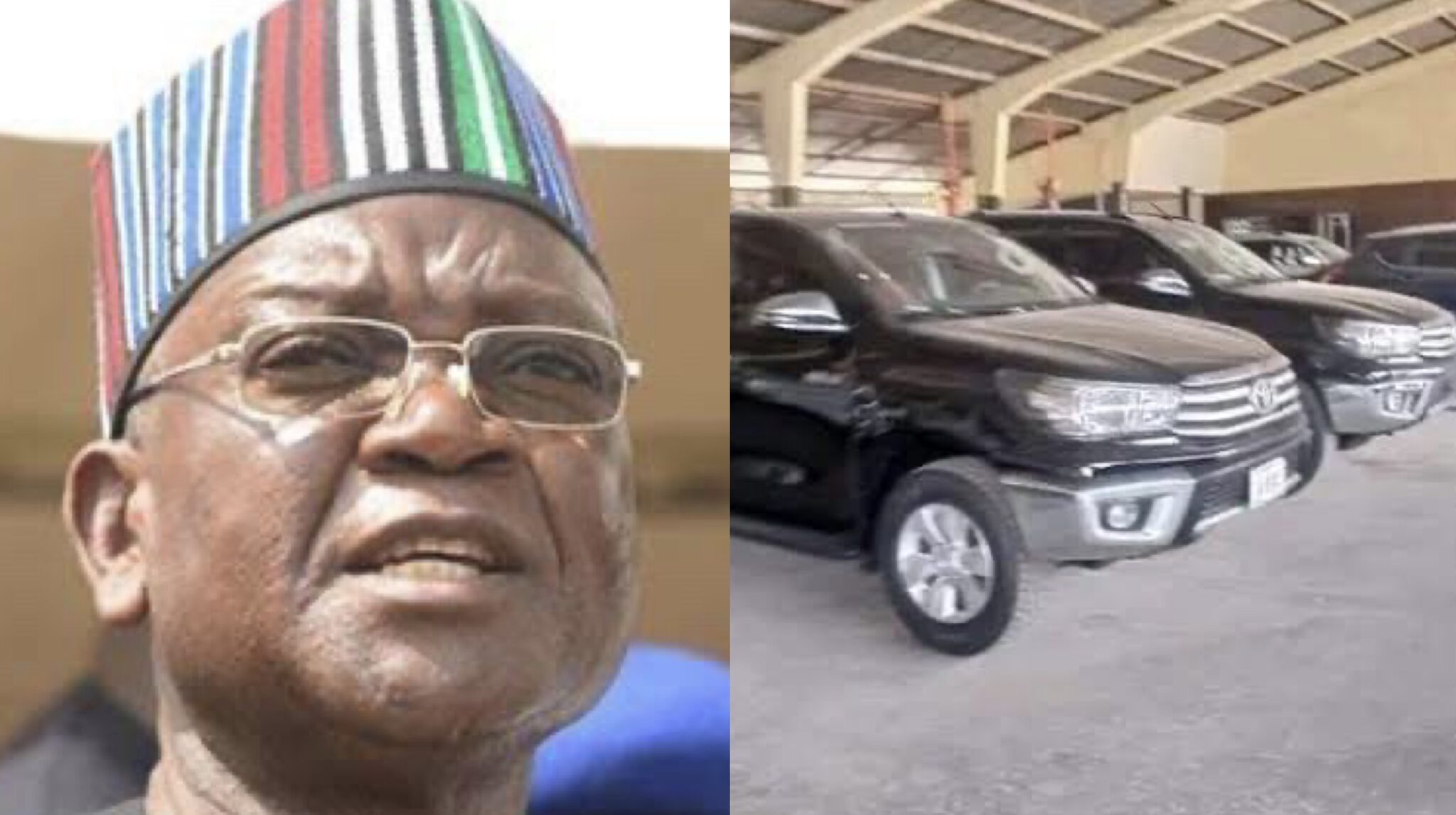
Former Benue State Governor, Samuel Ortom, may have intended to use his recent television appearance to accuse the administration of Governor Hyacinth Alia of witch-hunting and violating the rule of law. Instead, his own account of how he fought to retain 23 government vehicles after leaving office has raised a more fundamental question about public accountability and the proper use of state resources.
Speaking on Arise TV, Ortom acknowledged that 23 vehicles allegedly allocated to him by the Benue State Government while he was governor were taken back after he left office. According to him, he challenged the action in court and secured a judgment directing the return of the vehicles and awarding him N5 million.
The former governor described the vehicles as having been “legitimately given” to him by the government and portrayed their recovery by his successor’s administration as part of a campaign of persecution against him.
But that explanation leaves Nigerians asking a simple question: who, exactly, constituted “the government” that allocated 23 vehicles to Ortom while he was himself the head of that government?
The issue is not merely whether the former governor won a court case. The larger issue is the propriety of a public office holder benefiting personally from the allocation of such a large number of state-owned vehicles and subsequently insisting that they belonged to him after leaving office.
Governors are custodians of public resources, not owners of state assets.
A vehicle purchased, maintained or allocated from public funds does not automatically become the personal property of a governor simply because it was assigned to him while he occupied office. There is an important distinction between a vehicle allocated for official use and an asset transferred permanently into the private ownership of a public office holder.
That distinction deserves to be made crystal clear.
If the 23 vehicles were indeed transferred to Ortom as his personal property under a valid government policy, then the public deserves to know the legal and administrative basis for such an extraordinary allocation. Who authorised it? What policy permitted it? Were the vehicles purchased specifically for the governor’s personal use or were they government fleet vehicles? Were they properly valued and documented? Were they transferred to him before or after he left office?
These are not witch-hunting questions. They are legitimate questions of accountability.
Indeed, the sheer number—23 vehicles—is what makes the matter particularly troubling.
For an ordinary Nigerian struggling to pay rent, school fees, medical bills and transportation costs, the spectacle of a former governor fighting to retain 23 state vehicles inevitably creates the impression of a political class operating by a different set of standards.
Ortom’s assertion that he won in court and was awarded N5 million may settle a particular legal dispute, but a court judgment should not automatically be presented as proof that the underlying conduct was morally beyond criticism.
The courts determine disputes according to law and evidence placed before them. Public accountability, however, also involves questions of prudence, ethics and stewardship.
Even if Ortom’s legal claim was upheld, Nigerians are entitled to ask whether it was appropriate for a former governor to leave office with 23 vehicles allegedly allocated to him during his tenure.
There is also a broader principle at stake: public office should not become a mechanism for converting public assets into private possessions.
If every former governor could point to an “allocation” made while he was in office as justification for retaining substantial government assets after leaving office, then the distinction between public property and private property would become dangerously blurred.
There is an undeniable irony in Ortom’s criticism of the alleged erosion of the rule of law in Benue while discussing a dispute involving 23 government vehicles.
The former governor said democracy is anchored on the rule of law and accused the Alia administration of witch-hunting political opponents.
Those are serious allegations and should be tested on their merits.
But the same standard of accountability should apply to Ortom.
A former governor who invokes the rule of law should also welcome questions about the legal framework governing the disposal and allocation of government property. He should be willing to explain to Benue taxpayers why 23 vehicles were allocated to him and on what basis he believed he was entitled to retain them after leaving office.
Rather than dismissing public criticism as political persecution, Ortom should provide the documents that establish the nature of the allocation.
The controversy also touches on the larger question of how Nigerian political office holders treat public resources.
Governors control enormous public assets while in office. They use official residences, convoys, aircraft, vehicles and other facilities provided at taxpayers’ expense. These benefits are justified by the demands of public office.
But the benefits are supposed to terminate, or be properly accounted for, when the office ends.
The culture in which political office holders allegedly leave with vehicles, furniture and other government property has long fuelled public cynicism about governance in Nigeria.
That is why the 23-vehicle controversy should not be reduced to another political quarrel between Ortom and Alia.
It should become an opportunity for Benue State and Nigeria to establish clear rules governing what governors can legitimately retain after leaving office.
The most damaging aspect of the controversy may therefore not be that Ortom admitted fighting for the vehicles. It is that he appears to see the matter principally as a confrontation between himself and his successor rather than as a question of public accountability.
Benue taxpayers—not Ortom, not Alia and not any political party—are the ultimate owners of the state’s assets.
If the vehicles were legitimately transferred to Ortom, the documentation should settle the matter.
If they were merely official vehicles assigned to him during his tenure, then the circumstances under which he sought to retain them deserve scrutiny.
Either way, the former governor should publish the relevant allocation documents and the legal basis for his claim.
That would do more to strengthen his rule-of-law argument than political accusations of witch-hunting.
For a former governor who governed Benue for eight years, the expectation should be higher—not lower.
Leadership is ultimately measured not by how much a public office holder can legally extract from the system, but by how much of the system he leaves intact for those who come after him.
The 23 vehicles may have been the subject of a court dispute. But the larger controversy is about something much bigger: whether Nigerian public officials understand that government property belongs to the people, not to whoever happens to occupy the Government House.