
Millions Face Acute Hunger Amidst Insecurity in Nigeria
By Prof Osagiede Ikhimwen
Northern Nigeria is facing its most severe food security crisis in almost a decade, with conflict, displacement and dwindling humanitarian funding combining to push millions of people closer to hunger and desperation.
For years, the region has endured a complex humanitarian emergency driven by insurgency, climate shocks, economic hardship and mass displacement.
More than a decade of violence linked to the Boko Haram insurgency and its splinter groups has devastated farming communities, destroyed infrastructure and displaced millions of people, particularly across Borno, Adamawa and Yobe states.
Although military operations have recovered some territories, insecurity continues to prevent many families from returning home or cultivating their land.
The latest Cadre Harmonisé food security analysis paints a grim picture: more than 17 million people across nine conflict-affected states are now experiencing crisis, emergency or catastrophic levels of hunger.
The figure represents an increase of nearly two million people since the previous assessment, underscoring the speed at which conditions are deteriorating.
The Cadre Harmonisé, the food security classification system used across West Africa, measures the severity of hunger on a five-phase scale.
Phase 3 indicates a crisis requiring urgent humanitarian assistance, Phase 4 represents emergency conditions marked by severe food consumption gaps and high acute malnutrition, while Phase 5—catastrophic hunger—is the highest level, where starvation, destitution and death become an immediate threat without urgent intervention.
At the heart of the crisis is Borno State, where renewed insurgent attacks and reduced humanitarian assistance have left communities increasingly vulnerable.
More than three million residents are acutely food insecure, including over 750,000 people suffering severe hunger. More than 10,000 people have already fallen into catastrophic hunger—the most extreme level of food insecurity, where lives are at immediate risk.
Although this group represents only a fraction of those affected, humanitarian agencies say it is a stark warning that the situation is worsening rapidly.
The United Nations World Food Programme (WFP) says the crisis is no longer confined to traditional conflict hotspots in the northeast.
Violence is spreading into wider parts of northern Nigeria, disrupting farming activities, forcing families from their homes and making it increasingly difficult for aid agencies to reach those in need.
In recent years, insecurity has also escalated in the North West and North Central regions, where armed banditry, farmer-herder clashes and criminal kidnappings have forced thousands of rural households to abandon their farms. The expansion of violence into these important agricultural zones has further reduced food production, disrupted local markets and driven up food prices.
“What concerns us most is how this crisis is expanding,” said Kinday Samba, WFP Regional Director for West and Central Africa. According to him, as insecurity spreads, hunger follows closely behind because people are unable to cultivate their land while humanitarian access continues to shrink.
Nigeria’s broader economic challenges have compounded the crisis. Rising inflation, high transportation costs and the depreciation of the naira have significantly increased the price of staple foods, placing nutritious meals beyond the reach of many households.
Poor families are increasingly resorting to negative coping strategies such as skipping meals, reducing portion sizes, selling productive assets or withdrawing children from school to supplement household income.
Aid operations are facing mounting obstacles. The number of locations that humanitarian workers cannot easily access has doubled, with 15 additional areas now classified as partially inaccessible.
Attacks along major transport corridors and the proliferation of illegal checkpoints have disrupted the movement of relief supplies, forcing WFP to rely increasingly on costly air transport to reach isolated communities.
Compounding these operational challenges is a severe funding crisis. Global humanitarian needs have risen sharply in recent years as conflicts and climate-related disasters stretch donor resources across multiple emergencies, leaving agencies increasingly unable to fully fund operations in protracted crises such as northeastern Nigeria.
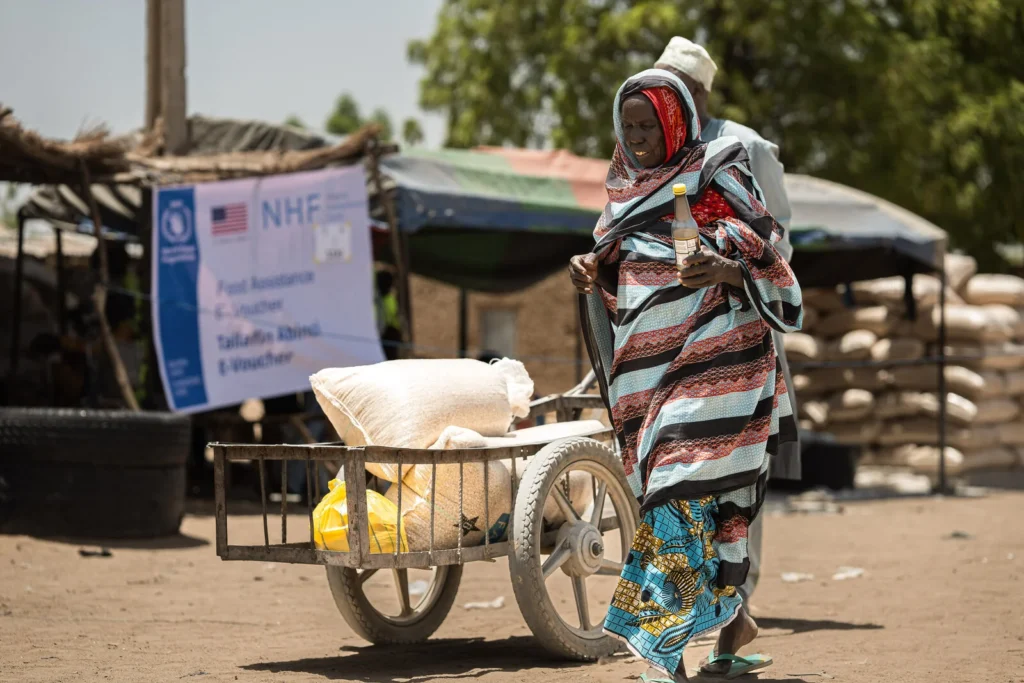
While the number of food-insecure people in the three northeastern states has risen to 6.2 million, WFP currently has sufficient resources to assist only about 740,000 people. More than 5.5 million people—many of them children—are therefore left without lifesaving food and nutrition support.
The contrast with previous operations is striking. During the peak of the 2025 lean season, WFP was able to assist approximately 1.3 million people, nearly double the number it can currently reach.
The lean season, which typically runs between June and September before the main harvest, is traditionally the period when household food stocks are at their lowest. During this time, families often rely heavily on humanitarian assistance or market purchases to meet basic food needs.
Any disruption in aid or farming activities during these months can rapidly push vulnerable households into acute hunger.
Humanitarian officials warn that the consequences of shrinking assistance extend far beyond hunger.
Communities have reported that some desperate individuals are joining armed groups simply to secure food or income, illustrating how prolonged food insecurity can fuel instability and deepen conflict.
Women and children are bearing an especially heavy burden.
The suspension of food assistance in some displacement camps due to funding shortages has reportedly led to an increase in exploitation and gender-based violence, exposing already vulnerable populations to additional risks.
Children also face heightened risks of acute malnutrition, disease outbreaks and interrupted education as families struggle to survive.
“When people lose access to food, the risks of displacement, exploitation and instability increase. Yet resources are at their lowest at the time they are needed most,” Samba warned.
For humanitarian agencies, the crisis highlights the close relationship between security, agriculture and economic recovery. Without sustained investment in both emergency food assistance and long-term livelihoods, experts warn that communities emerging from years of conflict may remain trapped in a cycle of hunger, displacement and dependence on aid.
To prevent the crisis from spiralling further, WFP says it urgently requires 89 million US dollars over the next six months to sustain food and nutrition assistance, as well as critical logistics operations across northern Nigeria. Without immediate financial support, the agency warns that hunger will deepen, more families will be displaced and instability could spread further across the region.
As the lean season intensifies, humanitarian organisations caution that the window to avert a much larger catastrophe is rapidly closing.
Without swift action from donors, governments and development partners, millions of vulnerable Nigerians could face even harsher months ahead, with consequences that extend beyond food insecurity to regional stability and long-term recovery.