
APM Presidential Candidate, Makinde Says Oyo Got More Money, Admits His Failure to Fight Hunger
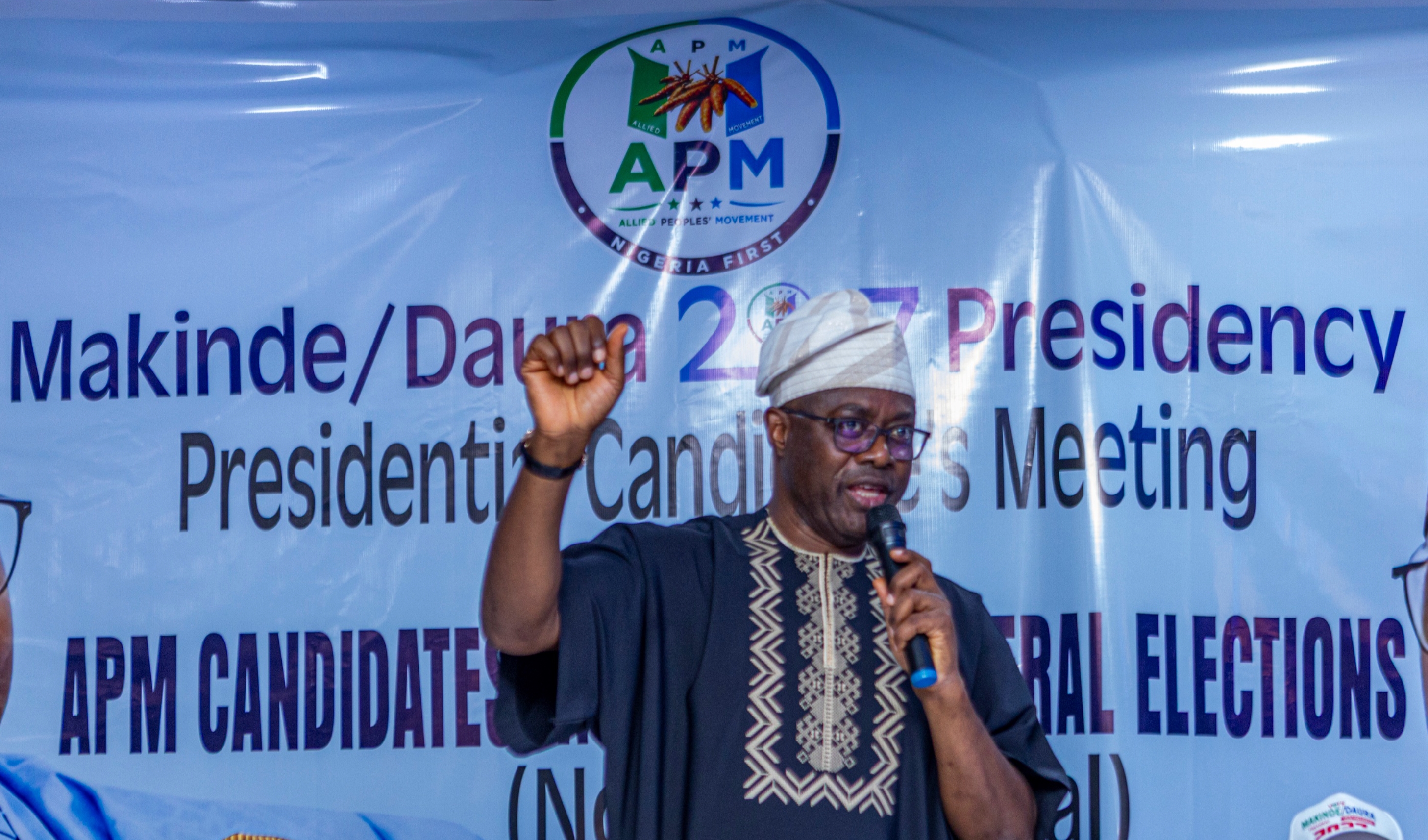
APM presidential candidate, Gov Makinde
By Marian Alekhue
Governor Seyi Makinde of Oyo State has admitted that state governments are receiving substantially more money from the Federation Account following the removal of fuel subsidy by President Bola Ahmed Tinubu, but said the increased revenue has not translated into an end to hunger in the country.
Makinde, who is the presidential candidate of the Allied Peoples Movement (APM), said Oyo State’s dependence on the Federation Account dropped from more than 80 per cent when he assumed office in 2019 to about 65 per cent in 2022, but later climbed back to almost 80 per cent.
He attributed the reversal largely to the changes in federal revenue distribution following the removal of fuel subsidy.
“Tinubu claims that state governors have more money, that the state governments have been collecting more money from the Federation Account. I’m not arguing with that. Yes, the quantum of the money, yes, we have more money, but has it translated to fighting hunger in our society? The answer is no,” Makinde said.
But the governor’s admission has opened another question: what has Oyo State itself done with the substantial increase in federal allocations available to it?
Since the removal of fuel subsidy, FAAC distributions have risen sharply. Total allocations to the three tiers of government increased from about N9.18 trillion in 2022 to N10.9 trillion in 2023 and N15.26 trillion in 2024, according to data from the Nigeria Extractive Industries Transparency Initiative (NEITI).
The states’ combined share also rose from about N3.58 trillion in 2023 to N5.81 trillion in 2024.
The revenue surge continued into 2025, with the three tiers receiving N33.27 trillion between January and November, representing an increase of about 30 per cent over the corresponding period of 2024.
Oyo State has been among the beneficiaries of the increased transfers.
The state’s 2025 budget documents projected a government share of FAAC of N423.22 billion, while internally generated revenue was projected at N143.19 billion.
The figures have therefore raised questions over the continued heavy dependence of Oyo’s finances on federal transfers, despite Makinde’s earlier claim that his administration had succeeded in reducing the state’s dependence on FAAC.
Critics contend that the increase in federal revenue should provide state governments with greater fiscal space to invest in productive sectors, infrastructure, agriculture, employment, education, healthcare and measures capable of reducing dependence on federal transfers.
Instead, they argue, the fundamental problem of state-level economic dependence remains largely unresolved.
The Save Oyo Movement (SOM), in particular, has accused the governor of allegedly diverting state resources into political activities associated with the APM and his 2027 presidential campaign.
In a statement signed by its coordinator, Comrade Akeem Oladiti, the group alleged that Makinde had, in the last six months, been releasing huge monthly subventions for the running of the APM, including alleged payment of salaries and allowances of party officials.
SOM also alleged that more than 30 Hilux vehicles had been purchased and were being distributed to political coordinators across the state.
The group further claimed that some of the vehicles initially parked at Makinde’s Abuja campaign office had been moved to undisclosed locations.
The allegations have not been independently established, and neither Makinde nor the Oyo State Government has been shown in the report as having responded specifically to the claims.
SOM consequently called on the Economic and Financial Crimes Commission (EFCC) and the Independent Corrupt Practices and Other Related Offences Commission (ICPC) to investigate the finances of Oyo State and alleged expenditure on the APM.
The group also attacked the APM’s call for President Tinubu to step aside for Makinde in 2027, describing the demand as politically unserious and alleging that the governor’s presidential ambition was being used to justify the alleged funding of the party.
But beyond the political accusations, Makinde’s own comments have brought the issue of revenue management to the centre of the debate over his record in Oyo State.
If, as the governor acknowledges, states now have substantially more money from the Federation Account, the critical economic issue is how effectively those additional resources are being converted into productive investment, jobs, infrastructure, food security and internally generated revenue.
For Oyo State, the published budget figures provide a basis for examining that question.
The state’s continuing reliance on FAAC, despite the governor’s earlier claim of reducing dependence on federal allocations, is likely to become an important issue as Makinde campaigns for the presidency in 2027.