
Reform, Reversal or Protection: The Economic Choices Facing Nigeria in 2027
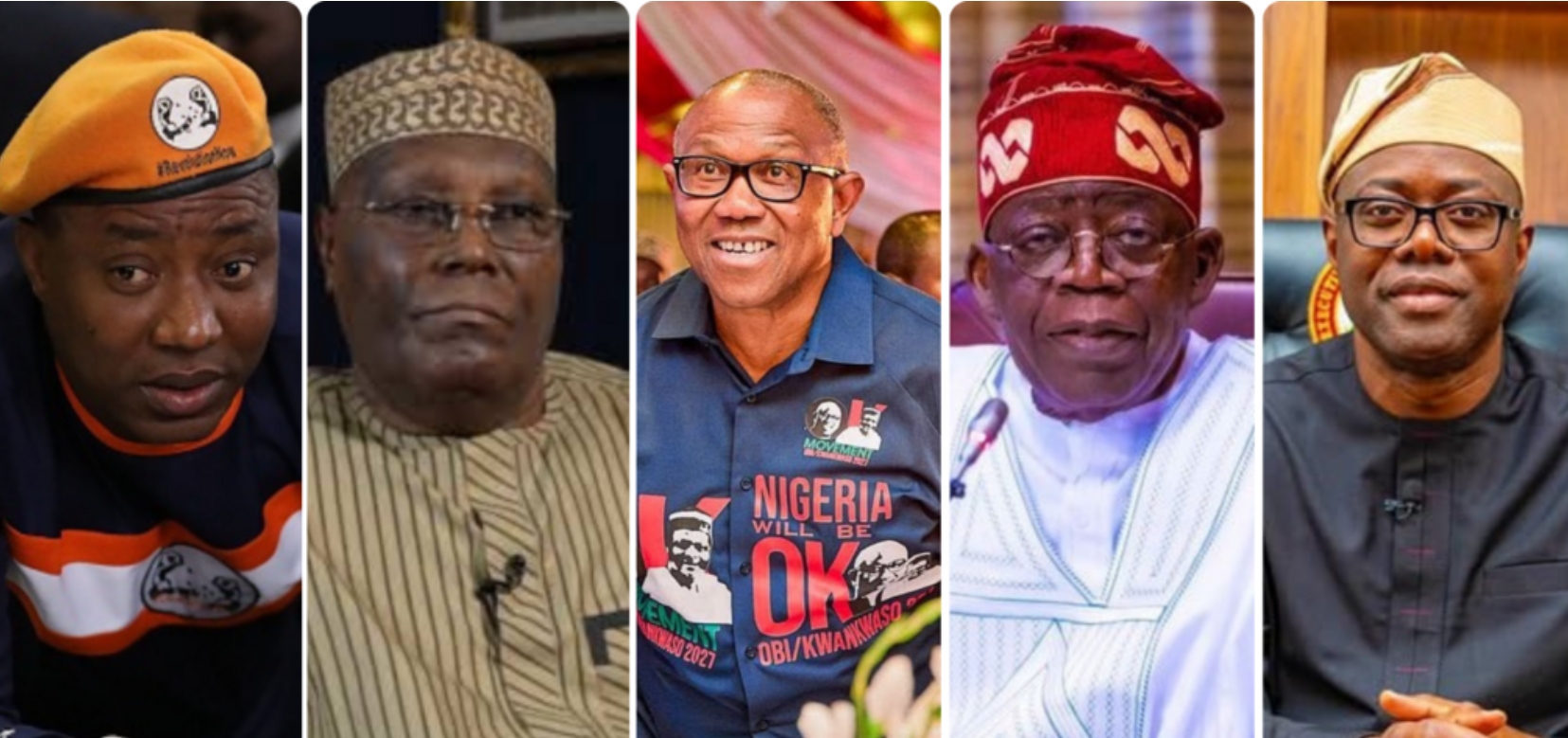
Sowore, Atiku, Obi, Tinubu, Makinde
By Orobosa Omo-Ojo JP
The 2027 presidential election is shaping up as a referendum on the direction of Nigeria’s economic reforms, with the removal of the petrol subsidy, foreign-exchange liberalisation, tax reforms and changes to trade policy emerging as some of the defining issues in the contest.
A new analysis by Dataphyte, Election Watch 2027: Presidential Candidates’ Plans for Nigeria’s Economic Reforms, examines the positions of 18 presidential candidates and shows that the major contenders are divided less over whether Nigeria needs economic reform than over the pace, structure and social consequences of the reforms introduced by President Bola Tinubu since May 2023.
Tinubu’s administration inherited an economy characterised by multiple exchange rates, substantial fiscal pressure, fuel subsidies and weak government revenues. Its response has been to undertake a series of structural changes aimed at eliminating what it describes as long-standing distortions.
The consequences have been severe for households and businesses in the short term. Dataphyte reports that the average retail price of petrol rose from N238.11 per litre in May 2023 to between N540 and N545 in June 2023 following subsidy removal, and subsequently reached an average of N1,596 per litre three years later. The resulting increase in transportation and production costs has contributed to pressure on household purchasing power.
But the economic argument behind the reform is that Nigeria could no longer sustain the previous system without sacrificing fiscal stability.
The World Bank has independently described the post-2023 measures as “bold reforms” that have helped restore macroeconomic stability. Its April 2026 Nigeria Development Update said inflation had eased markedly, while Nigeria’s external and fiscal positions had strengthened and economic growth remained robust, although household incomes had not fully recovered and poverty remained high.
The subsidy question therefore sits at the centre of the 2027 debate. Tinubu announced the end of the petrol subsidy at his inauguration on May 29, 2023. The administration’s argument has been that scarce public resources should no longer be used to subsidise consumption in a system that had become expensive and difficult to administer, but should instead be redirected towards infrastructure, social intervention and productive investment.
Dataphyte reports that the presidential candidates have responded differently. African Democratic Congress candidate Atiku Abubakar has moved towards restoring the subsidy, arguing that Nigerians have not benefited sufficiently from the savings. African Action Congress candidate Omoyele Sowore advocates continued support for fuel and vulnerable citizens while targeting alleged corruption and leakages. Peoples Redemption Party candidate Donald Duke emphasises domestic refining, while Nigeria Democratic Congress candidate Peter Obi supports retaining subsidy removal but argues that the savings must be transparently invested in productive sectors. SDP candidate Adewole Adebayo also focuses on reducing petroleum prices through domestic refining and expanded local processing.
The fundamental disagreement, therefore, is not simply about petrol prices. It is about whether Nigeria should return to subsidising consumption or maintain the reform and use the resulting fiscal space to build productive capacity.
There is independent evidence supporting the fiscal rationale for the reform. The World Bank estimated that the gains from the removal of the PMS subsidy amounted to about 2.6 per cent of GDP in 2024, while Nigeria’s total revenues rose sharply, from 4.8 per cent of GDP in 2022 to 8.4 per cent in 2024. The Bank said the additional fiscal resources could be used for priority spending on education, health and critical infrastructure.
The second major pillar of the Tinubu programme has been the unification of the foreign-exchange market. In June 2023, the Central Bank of Nigeria abandoned the previous multiple-rate structure in favour of a more market-determined system. The naira subsequently depreciated sharply, creating substantial short-term pressure on importers, manufacturers and consumers.
Dataphyte reports that Atiku and Sowore have criticised the scale of the depreciation and its consequences, while Obi has indicated that he would retain the core of a market-determined exchange-rate system but seek stronger coordination between monetary and fiscal policy.
The administration’s argument is that maintaining artificial exchange rates would continue to generate distortions, discourage investment and create opportunities for arbitrage.
Again, the World Bank’s assessment provides an important independent dimension. Its latest country overview says the unification of the exchange-rate market and movement towards market-reflective pricing reduced fiscal distortions and improved external balances. By 2025, Nigeria’s foreign reserves had surpassed $42 billion, while the economy recorded 3.9 per cent growth in the first half of the year.
The World Bank also reported that inflation declined from 33.2 per cent in 2024 to 23 per cent in 2025, although it stressed that inflation remained high and poverty continued to be a serious concern.
The tax and trade reforms represent another major component of the administration’s economic restructuring. Tinubu signed four new tax laws in June 2025, establishing a new framework for tax administration, revenue collection and coordination among the different levels of government. The administration says the reforms are intended to simplify the tax system, improve compliance, strengthen revenue mobilisation and create a more predictable environment for businesses.
Dataphyte also reports that the administration reduced import duties on selected food products, vehicles and industrial inputs in April 2026, including reductions affecting passenger vehicles, bulk rice and palm oil, while granting exemptions for some electric vehicles, mass-transit buses and manufacturing machinery.
The presidential candidates again offer contrasting alternatives. Atiku has proposed opening Nigeria’s land borders and improving southern ports to facilitate legitimate trade. Obi has criticised what he considers excessive customs charges and argues for lower costs of doing business. Adebayo proposes a longer-term industrial strategy designed to reduce dependence on imported goods through domestic production, reliable energy and manufacturing expansion.
The 2027 economic debate therefore presents Nigerians with competing approaches to the same fundamental problem: how to move an economy dependent on oil revenue, imports and government intervention towards one driven by production, investment, taxation and private-sector activity.
The strongest evidence in support of the Tinubu administration’s approach is not simply the government’s own defence of its policies. It is the emerging evidence that some of the macroeconomic distortions the reforms were designed to address have begun to recede.
The World Bank says Nigeria’s recent reforms have improved macroeconomic stability, strengthened revenues and reserves and enhanced exchange-rate flexibility. It says the changes provide a foundation for deeper structural reforms, including better public services, infrastructure investment and stronger private-sector participation.
The Bank’s May 2025 assessment similarly found that the fiscal position had improved substantially, with the debt-service-to-revenue ratio falling from 100 per cent in 2022 to below 40 per cent in 2024, largely because of the sharp increase in government revenues.
That does not erase the social cost of the reforms. The World Bank continues to warn that poverty remains high, household incomes have not fully recovered and food inflation continues to impose a disproportionate burden on poorer Nigerians. It has therefore called for stronger social protection and more efficient public spending alongside continued macroeconomic reforms.
The economic question entering 2027 is consequently becoming more precise than whether reform was necessary. It is whether Nigeria should reverse the structural changes, preserve them while modifying their implementation, or accelerate them while doing more to distribute their benefits.
For Tinubu, the central argument is that Nigeria cannot return to the fiscal and foreign-exchange arrangements that produced persistent distortions simply because the transition has been painful. The administration’s case rests on maintaining the gains from subsidy reform, exchange-rate unification and improved revenue mobilisation, while using the resulting fiscal space to expand infrastructure, production, social protection and investment.
For the opposition candidates, the argument is that the same reforms must either be reversed, substantially modified or accompanied by stronger protection for households and businesses.
The 2027 election will therefore put not only personalities and political parties on the ballot, but two competing questions about Nigeria’s economic future: whether to preserve the architecture of the Tinubu reforms that has been applauded by global economy watchers, and improve their social outcomes, or substantially change the direction in which the economy has been moving since 2023 to an era that stagnated the nation’s growth.