
The Golden Rule from a Legal and Legislative Perspective: Advancing Development for Underserved Communities
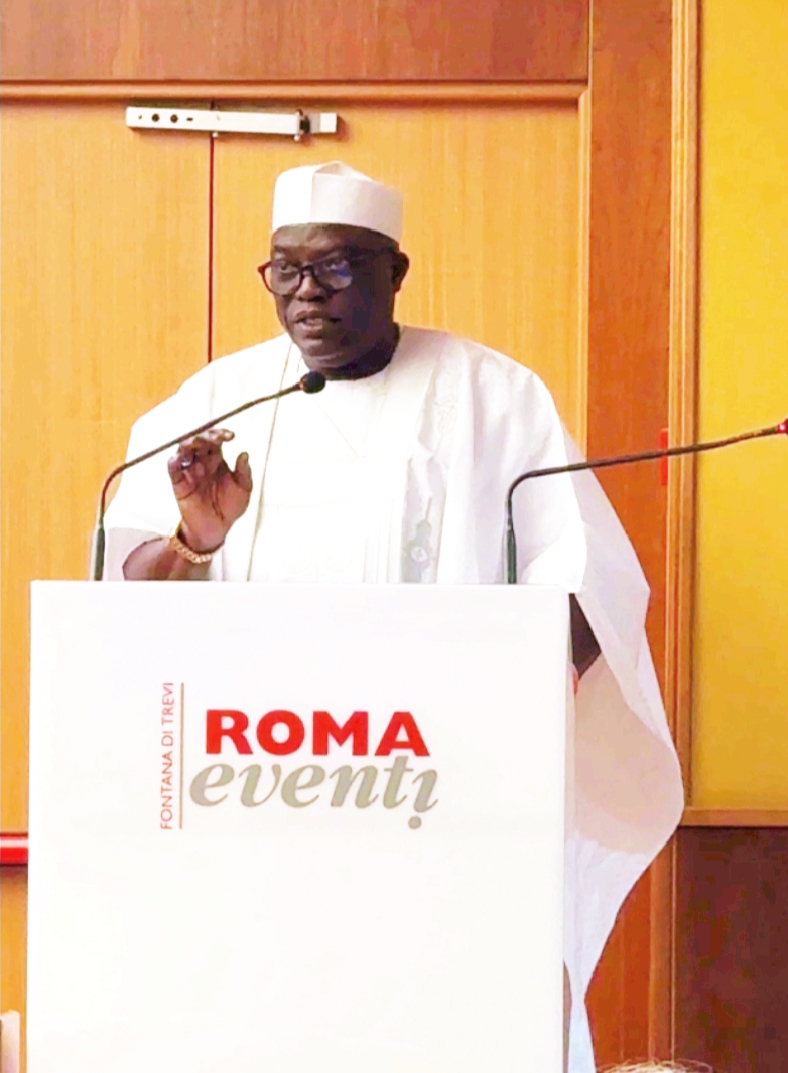
Senator Neda Bernards Imasuen delivering his address at The Golden Rule Summit, Rome, Italy.
Full text of his address as delivered at The Golden Rule Summit, Rome, Italy, October 19–22, 2026
By Senator Neda Imasuen
My assigned topic is “The Golden Rule from a Legal and Legislative Perspective: Advancing Development for Underserved Communities.”
Upon reflecting on this topic, I will try to connect three things:
The Injustice
How global economic arrangements can leave resource-rich nations and their communities with disproportionately little benefit.
The Human Consequences
How this contributes to limited employment opportunities, inadequate infrastructure, poverty, and missed opportunities.
The Legislative Solution
How laws, ethical governance, fair trade agreements, and international cooperation can create more equitable outcomes.
We speak of the Golden Rule as a principle governing how individuals should treat one another. But I ask us today: Should that same principle not apply to how nations conduct business with one another?
When a nation exports its natural wealth but must import finished products at significantly higher prices, we must examine whether our economic relationships are delivering equitable development.
This is not about assigning blame. It is about acknowledging that fairness must extend beyond personal conduct to the laws, institutions, and economic systems that govern our world.
For centuries, less privileged nations have been, and indeed remain, on the receiving end of economic imbalances.
In Nigeria, for example, Your Highness, our host, cocoa is cultivated in commercial quantities. This product is exported to more developed economies at relatively low prices. However, finished products—chocolate and its derivatives—are imported into Nigeria at much higher prices. Frankly, most Nigerians cannot afford chocolate.
The consequences of this situation contribute, in part, to unemployment and a lower standard of living, which, in turn, encourage large-scale migration by people seeking better living conditions in developed economies.
How would the benefits of this economic relationship be shared more equitably if a chocolate factory were established in Osun or Edo State?
Would it reduce the economic imbalance? Would it lead to lower unemployment? Would it ultimately reduce irregular migration or human trafficking?
These are questions worth considering.
This is not to absolve our leaders of responsibility for systemic failures, but rather to draw attention to the principles of the Golden Rule: “Do unto others as you would have them do unto you.”
Would these developed economies wish to experience the same kind of economic imbalance to their disadvantage if the situation were reversed?
The Legislative Perspective: Nigeria
From a legislative perspective, may I direct my attention to the Nigerian Parliament?
The Nigerian Parliament, under the able leadership of the President of the Senate, Senator Godswill Akpabio, has addressed some of these issues through legislation. We have successfully passed legislation establishing the student loan fund, which enables students to access funds for their education and upkeep. These loans attract minimal interest and are repayable only when the beneficiaries graduate and become gainfully employed.
The Parliament has also reviewed and passed impactful economic reforms, including tax legislation. The new tax laws, for example, empower and encourage small and medium-sized enterprises (SMEs). Under these laws, SMEs enjoy tax breaks and, in some instances, are completely exempt from certain taxes.
Our economic policies, particularly those of the present administration, headed by our President, His Excellency Senator Bola Ahmed Tinubu, include initiatives intended to place people at the centre of development.
The administration is addressing trade and commerce imbalances where possible and pursuing relationships with other economies to strengthen our industries, with the overarching objective of improving the standard of living of our citizens.
The Government of Nigeria is also providing the much-needed enabling environment for businesses to thrive. The widely discussed Dangote Refinery is an example of a business enterprise that has benefited from an environment in which such a world-renowned refinery could be built.
The government has also taken steps to address irregular migration and human trafficking through policies and programmes designed to engage citizens in skills development and service opportunities.
I believe that, through government cooperation and the advancement of people-centred policies that address the needs and aspirations of citizens, we can make meaningful progress towards equitable development.
Human Rights, Human Dignity, and the Golden Rule
Legislation, government policies, and laws must also address issues of human rights equitably.
Human rights violations undermine human dignity. We are all creations of God. Therefore, in our dealings with one another, we must ask ourselves whether our actions, the laws we advance, and the policies we formulate respect human dignity.
Do they promote the Four-Way Test of Rotary International, an organisation to which I proudly belong?
The Four-Way Test asks:
- Is it the truth?
- Is it fair to all concerned?
- Will it build goodwill and better friendships?
- Will it be beneficial to all concerned?
If we can apply these four questions to our human dealings—whether from person to person, from nation to nation, or in the relationship between governments and their citizens—perhaps we will be practising the Golden Rule in real terms: “Do unto others as you would have them do unto you.”
Conclusion
As I conclude my speech today, Your Highnesses, religious leaders present here, ladies and gentlemen, may I leave you with this question:
“If we would not accept inequality for our own communities, why should we accept it as an enduring feature of the global economic order?”
I thank you all very much for your time.
Senator Neda Bernards Imasuen, Esq., represents Edo South Senatorial District in the Nigerian Senate, where he chairs the Committee on Ethics, Code of Conduct and Public Petitions. He is a member of Rotary International.