

Flying Against the Headwinds: Allied Air and the Challenge of African Logistics
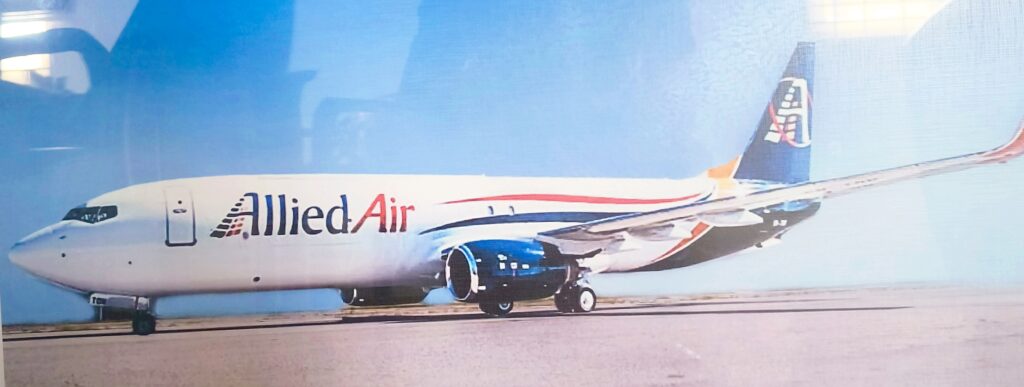
Allied Air
By Orobosa Omo-Ojo (Publisher)
The story of air cargo in Africa is often told through statistics about growing trade volumes, expanding e-commerce markets, and the promise of the African Continental Free Trade Area (AfCFTA). Yet beneath the optimism lies a more complex reality: Africa remains one of the most logistically challenging regions in the world, with inadequate infrastructure, fragmented transport networks, regulatory bottlenecks, and high operating costs continuing to impede the movement of goods.
In this difficult environment, Nigerian cargo airline Allied Air has emerged as one of the continent’s most prominent dedicated freight operators. But its significance lies not simply in its operational achievements. Rather, Allied Air’s story illustrates both the resilience of private-sector logistics providers and the broader challenges that continue to constrain Africa’s supply chain ecosystem.
For decades, infrastructure has been one of Africa’s biggest barriers to trade competitiveness.
While the continent accounts for a growing share of global population and economic activity, its logistics networks remain underdeveloped. Roads connecting production centres to ports are often congested or poorly maintained. Rail systems are limited in coverage. Many airports lack modern cargo handling facilities, cold-chain infrastructure, and efficient customs processes.
Nigeria exemplifies many of these challenges. As Africa’s largest economy, it possesses enormous trade potential, yet businesses frequently face delays caused by road congestion, port inefficiencies, inadequate warehousing, unreliable electricity supply, and high transportation costs.
The consequences are significant. Supply chain disruptions increase the cost of doing business, reduce the competitiveness of exports, and discourage investment in manufacturing and value-added production.
Against this backdrop, air freight has become a critical, though expensive, alternative for businesses moving time-sensitive cargo.
Air freight offers speed and reliability, especially where road and rail infrastructure are weak. For pharmaceutical products, spare parts, electronics, perishables, and urgent industrial supplies, air transport can mean the difference between commercial success and costly delays.
Yet air cargo itself faces significant constraints.
African airlines collectively account for only a small share of global air cargo capacity. Many countries lack dedicated cargo carriers, forcing businesses to rely on passenger aircraft belly-hold capacity or foreign operators. Limited connectivity between African cities means cargo is often routed through Europe or the Middle East before reaching neighbouring African markets.
These structural limitations increase costs and undermine efforts to deepen intra-African trade.
This is where carriers such as Allied Air have carved out an important niche.
Founded in 1998 by Captain Valentine Tongo, Allied Air has become Nigeria’s leading dedicated cargo airline and one of the few indigenous freight carriers operating extensive regional networks.
Its operations connect Lagos with major commercial centres across West, Central, and East Africa, providing direct cargo services that help reduce dependence on foreign logistics hubs.
The airline’s contribution is particularly important because dedicated cargo operators remain relatively rare in Africa. In many countries, freight services are still treated as secondary activities attached to passenger operations rather than as specialised logistics businesses.
By focusing exclusively on cargo, Allied Air has helped strengthen regional freight connectivity and provided an important transportation option for businesses requiring reliable delivery schedules.
However, even companies like Allied Air remain constrained by the wider logistics ecosystem in which they operate.
One of the recurring themes in African logistics is that private-sector operators often compensate for infrastructure deficiencies that should ideally be addressed through public investment.
Cargo airlines can move freight efficiently between airports, but they cannot solve poor road access to industrial zones. Modern aircraft can reduce transit times, but they cannot eliminate customs delays or bureaucratic bottlenecks. Warehousing investments improve cargo handling, but they cannot replace national cold-chain infrastructure.
As a result, logistics companies frequently bear higher operating costs than their counterparts in developed markets.
For Nigerian operators, additional pressures include fluctuating exchange rates, aviation fuel costs, limited access to long-term financing, airport infrastructure challenges, and regulatory uncertainty. These factors affect profitability and make fleet expansion more difficult.
The challenge is not unique to Allied Air. It is shared by logistics companies across the continent.
The launch of the African Continental Free Trade Area has renewed discussions about the need for stronger transport networks.
The agreement seeks to create a single African market and boost intra-African trade. Yet trade liberalisation alone cannot overcome physical connectivity challenges.
Experts frequently point out that Africa’s infrastructure gap remains one of the biggest obstacles to achieving AfCFTA’s objectives. Goods cannot move efficiently without integrated transport systems, modern ports, functional rail networks, and reliable cargo aviation services.
In this context, Allied Air represents an example of how private operators are helping build the connectivity required for continental trade integration.
Its regional cargo routes contribute to linking markets that have historically been underserved, supporting businesses seeking access to customers across borders.
Nevertheless, the airline’s success also highlights a broader reality: Africa needs many more such operators, supported by far greater investment in logistics infrastructure.
Perhaps the most important lesson from Allied Air’s experience is that supply chains function as ecosystems rather than isolated businesses.
An efficient cargo airline depends on efficient airports. Efficient airports depend on reliable power supply, digital customs systems, and quality road access. Export growth depends on storage facilities, cold-chain infrastructure, and trade-friendly regulations.
Without these interconnected investments, logistics improvements remain limited.
For Nigeria, improving supply chain competitiveness will require coordinated action across aviation, maritime transport, rail, roads, customs administration, and trade policy. For Africa, the challenge is even larger: creating an integrated logistics network capable of supporting a continent-wide market.
Viewed in isolation, Allied Air’s growth from a small cargo operator to one of Africa’s leading dedicated freight airlines is a noteworthy achievement. Yet its greater significance lies in what it reveals about the state of African logistics.
The airline’s success demonstrates the capacity of indigenous companies to build globally competitive operations despite difficult conditions. At the same time, it underscores the scale of the work that remains.
As African economies seek deeper integration and greater participation in global value chains, logistics will increasingly determine competitiveness. Companies like Allied Air can help bridge the gap, but they cannot close it alone.
Ultimately, the future of African trade will depend not only on entrepreneurial success stories but also on whether governments and investors can build the infrastructure systems that allow those businesses to thrive.
Until then, cargo carriers such as Allied Air will continue to fly against the headwinds of an underdeveloped logistics landscape—connecting markets, supporting commerce, and demonstrating what is possible even in the face of persistent structural challenges.