
Flavoured Akara Kuli-kuli and Agbado Sours as Capital is Not Enough to Deliver Nigerian McDonald’s & Kellanova
Nigeria keeps telling its poor to start small. The real scandal is that small almost never becomes big — and that is a failure of policy, not of ambition.
Oluwatosin Emmanuel OLADETAN (MBA, ACCA, ACA, PMP, FMVA, BIDA, MICBC, NIM, TRCN)
Nigeria’s First Lady, Senator Oluremi Tinubu, recently spoke at a gathering of the Renewed Hope Initiative in Abuja, where she shared some inspiring words with grant beneficiaries. She said that getting out of poverty doesn’t have to be about having a lot of money.
According to her, starting a small business, like selling Akara, roasting corn, or making kuli kuli, doesn’t require a big investment or injection of capital at very pricy and exorbitant rate predominant within the Nigerian economic landscape circa 35%. What’s more, the First Lady explained that the beneficiaries didn’t receive loans, but rather grants, which is a significant difference.
This approach, she believes, can give people hope and help them improve their lives. By providing grants instead of loans, the initiative aims to empower individuals, especially those who may not have access to traditional funding sources.
The idea is to support small-scale entrepreneurs and help them grow their businesses, no matter how small they may seem. As Senator Tinubu pointed out, even a small venture like selling Akara or roasting corn can make a big difference in someone’s life, and it’s a step towards creating a better future.
The video spread quickly, as things like that often do. Some people criticized the government, saying they were out of touch with how much things cost.
Others, including some in the government, argued that there was nothing wrong with starting a business small, that selling akara, agbado and kulikuli was just the beginning – a way to learn about running a business, being disciplined, and growing. But both sides despite having their strong point are missing a valid point.
The problem with small businesses in Nigeria isn’t that they start small, because almost every successful business starts that way. The problem is that in Nigeria, small businesses often stay small. The woman selling akara is still selling akara at the same corner, the man grilling suya is still out at the junction till 1:00 am, for the same low profit, ten years later.
He or she is not failing because they are not working hard enough, but because the economy is designed to keep them in the same place.
Valid Dignity of Labour without Pivot Structure
I want to give the First Lady a fair chance before I present my view on her position on the subject matter under discussion.
There’s something to be said for the informal trade that keeps this country going, and I think grants are a more compassionate way to help people than loans.
She also talked about some real money that’s been committed to important causes through her office – ₦2 billion to fight tuberculosis, ₦1 billion for breast cancer, and ₦0.5 billion to tackle malnutrition. These are significant amounts, and they don’t deserve to be mocked or belittled.
The First Lady seemed sad that the conversation has shifted to blame the ordinary person, when really, they should be the ones who have hope. She said, “The narrative has really changed, to challenge the average man, whereas the average man is supposed to have hope.”
Having hope is one thing, but it’s not a plan for how to make things better. And just giving someone enough money to buy a frying pan and grill stand isn’t going to help position Nigeria as a great industrialist hub fo sustainable global innovation.
When the President’s wife talks about our big economic goals and only mentions simple things like roasted corn, it’s not mean-spirited. She’s actually showing us the limits of what the government is trying to do and then asking poor people to be thankful for the little they have.
This is what happens when you give up on the hard work of helping businesses succeed and instead focus on small, easy things – it’s like having an economy based on akara, kulikuli, suya and agbado traditional recipes. It’s not a real solution to our problems.
The Future Value of the present numbers is not scalable for Global Relevance
Let’s take a closer look at what these small businesses mean to Nigeria.
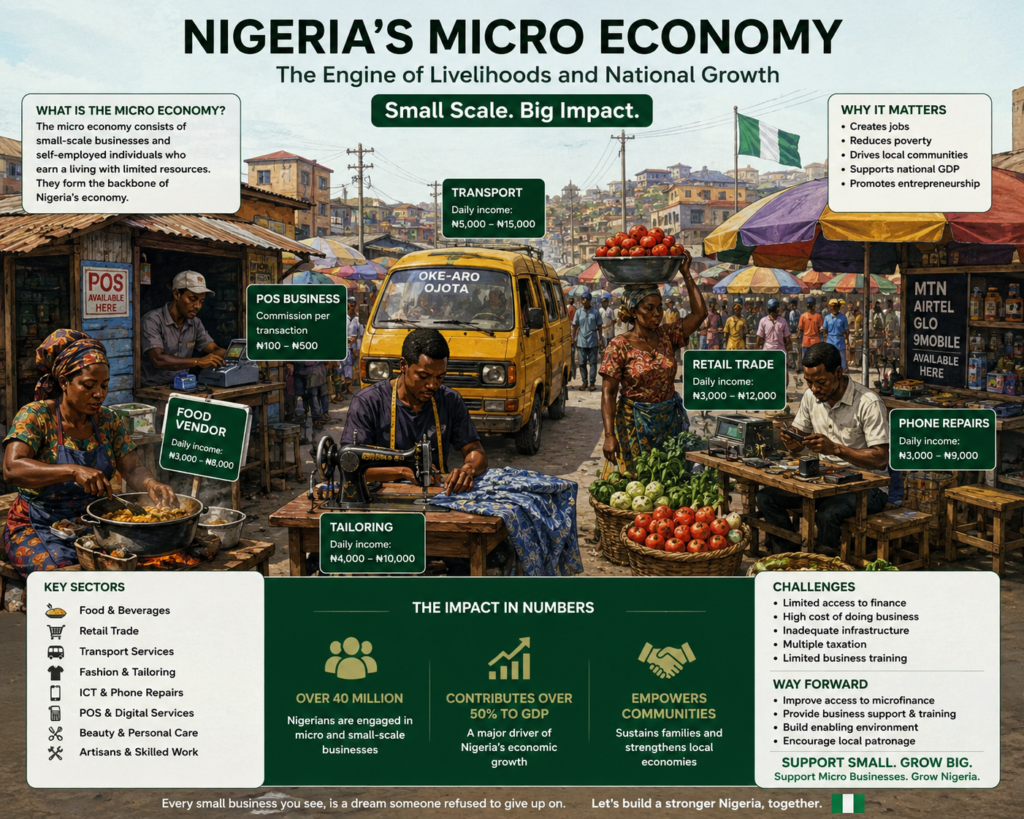
A recent national survey conducted by the Small and Medium Enterprises Development Agency and the National Bureau of Statistics reveals that there are over 39 million micro, small, and medium enterprises in the country. These businesses make up a staggering 96.9% of all businesses in Nigeria, providing employment to nearly 88% of the population, and contributing between 46% and 48% to the country’s gross domestic product (GDP).
This is not just a minor aspect of the economy – it is the backbone of Nigeria’s economic structure. If you were to remove the oil industry and the financial services from the equation, you would be left with a country that is primarily driven by the informal players consisting of traders, artisans, processors, and small-scale entrepreneurs. These individuals are the ones who are truly powering the Nigerian economy, and their contributions cannot be overstated.
If you take a closer look at the numbers, you’ll see that most of these small businesses are really tiny – like the person selling akara, kuli-kuli and agbado on the street corner or the kiosk where you can withdraw or top up your phone and utility bills on a POS machine. They usually just have the owner and maybe one other person helping out.
What’s really missing are the medium-sized businesses that can hire a lot of people, do their accounting properly, business management, tax remittances, disruption management, and even export goods to deliver a net surplus.
These kinds of businesses are hardly found at all. So, it’s not that the small business owners aren’t trying to grow, it’s just that the opportunities for them to move up are not there – it’s like the ladder to success has been cut off mid way, leaving them with no way to climb.
The Mai Shayi does not still have specialized flavoured tea from his plantation
If you ask a Nigerian business owner what’s holding them back, they won’t say it’s because they don’t have enough work to do. The real reasons are more complicated. For one, it’s hard to get the money they need to grow, and when they can, it’s expensive at over 30%. Then there is the problem of not having a reliable source of power, which makes it tough to get anything done as the machines, plants and equipment will not just eat kuli-kuli.
The value of the Nigerian currency can be unpredictable, making it hard to plan for disruptions in standard of living of which a classical example is the sporadic increase in accommodation and logistics rate. On top of that, following all the rules and regulations can be a real challenge, and it costs a lot to do business on a large scale.
All these issues combined make it difficult for businesses to thrive.
Let’s start with money, which is a major issue for businesses in Nigeria. In cities like Accra or Nairobi, businesses can borrow money at reasonable rates, but in Nigeria, lending rates are extremely high. To make matters worse, banks typically require collateral that’s equivalent to at least 130% of the amount being borrowed, which is a huge challenge for young firms that don’t have many assets.
While a grant to help someone start a so called big business, like frying akara or roasting agbado, is certainly helpful, it’s not enough to help entrepreneurs who want to grow their businesses. For example, a woman who wants to expand her small snack business into a packaged-snacks operation, which would involve registering a brand, leasing a unit, hiring staff, and selling to supermarkets, would find it impossible to get a loan from a bank that she could repay.
The irony is that Nigeria’s capital market is huge, with over ₦100 trillion in capitalization this year, which is a significant amount of domestic savings. However, almost none of this money is reaching the small businesses that employ most Nigerians. The problem is that the financial system is not set up to support these businesses, and as a result, they are struggling to access the capital they need to grow.
It’s like there’s a Chinese wall between the people who have money and the people who need it, and it’s preventing the economy from reaching its full potential. In short, the lack of access to capital is a major obstacle for entrepreneurs in Nigeria, and it’s holding back the country’s economic development. Something needs to be done to fix this problem and make it easier for small businesses to get the funding they need to succeed.
Electricity is a major issue. A company that can’t rely on a steady power supply is in trouble as almost all local stores in a Kano market have solar panels on their roof and a coordinated plan to totally disconnect from the grid.
For the businesses that have not tapped into the solar panels reform as a result of huge cost of large inverters and batteries can’t make plans, keep things cool, work extra hours, or use machines. So, it buys a generator, factors in the cost of diesel to everything it sells and passes that expense on to customers who are already struggling with low wages due to inflation. It’s hard to grow your business when your biggest competitor is the cost of electricity. You can’t overcome this problem just by throwing money at it.
Imagine running a small business in a country where the currency has lost a lot of its value in just two years. This means that everything you need to import, like machinery, packaging, spare parts, and raw materials, becomes a big challenge to budget for. It’s like trying to hit a moving target, and it’s really tough for small businesses to handle.
On top of that, there’s the problem of too much bureaucracy. If you try to do things the right way and register your business, you get punished with lots of taxes, fees, and regulations that seem designed to make it hard for you to succeed. The Small and Medium Enterprises Development Agency of Nigeria, SMEDAN, has pointed out that businesses that aren’t registered can’t get access to loans, incentives, or support.
But the system is so complicated and punishing that it feels like registering your business is just asking for trouble as you do not have the grit to benefit from the nepotism and corruption that makes the system to thrive. So, many entrepreneurs decide to stay small and unregistered, just to avoid all the hassle. This isn’t a choice they make because they want to, but because they have to. It’s a way of coping with a system that doesn’t seem to want to help them. The “akara economy,” as it’s called, isn’t a cultural thing – it’s just a way for people to survive in a tough environment.
The $1 trillion economy is still Microscopic under Advanced Binoculars
Nigeria’s government is really pushing the idea of having a one-trillion-dollar economy, and President Tinubu thinks they can make it happen by 2030. But when you look at the numbers, it’s a tough goal to reach. The country would need to grow at a rate of 10% to 12% every year, which is a lot.
Some experts even think it would have to be more like 17.6% and a I believe at least a 20% will suffice, which is basically unheard of in Nigeria’s history. It’s not like selling roasted corn on the street is going to make that kind of growth happen. The government is counting on private businesses to come up with about 86% percent of the investment needed to reach this goal. But the problem is, the state is telling these businesses to start small, like with just a frying pan and a grill, which doesn’t exactly seem like a recipe for huge success.
The targets keep changing, and it’s getting hard to keep up. The year we’re supposed to reach our goal keeps getting pushed back, and the numbers we’re using to make our predictions are being quietly tweaked. Meanwhile, the same old promises are being made at every big meeting, but things on the ground aren’t getting much better for the people actually making things or processing goods.
You can’t just magic up a trillion-dollar economy by putting all the weight on 39 million tiny businesses that aren’t allowed to grow beyond their owner. A strong economy is built by having tens of thousands of medium-sized companies that started small and were given the support they needed to expand. That’s the part of the process that Nigeria has been neglecting. We’re great at cheering on new startups, but we forget about helping them grow into something bigger.
The Nigerian Economic Nostradamus
So, what would it look like for the government to be proactive about productivity rather than performative about poverty? It begins by treating the SME not as a charity case to be handed a grant and a slogan, but as the engine of the economy it claims to be building. To really help small businesses grow, we need to sort out the cost of borrowing money.
The government’s plan to give ₦200 billion to small and medium-sized businesses is a good start, but we’ve seen this kind of thing before – the money often ends up in the wrong hands and doesn’t actually reach the people who need it. What’s really important is making sure that small businesses can get loans with low interest rates that they can pay back over a long period of time. The loans should be given out in a fair and transparent way, based on the business’s cash flow and digital payment history, rather than who they know or what assets they own. With the technology we have today, including open banking and fintech, this is totally possible.
The problem is that the people in charge aren’t using the country’s ₦100 trillion capital market to help small businesses – instead, they’re just investing it in government bonds. We need to change this and make sure that the money is going to where it can really make a difference.
Second, treat power as the precondition it is. Every naira spent helping a woman start frying akara is wasted if she must price diesel into every ball she sells. Distributed solar, functioning mini-grids and reliable supply to industrial clusters would do more for small-business productivity than a decade of motivational grants.
To really make a difference, the government should make it worth small businesses’ while to operate formally. This can be done by streamlining the various taxes and fees they have to pay, so they’re not getting hit with multiple taxes just for trying to do the right thing.
If small businesses register and play by the rules, they should get some real benefits in return. For example, they could get a break on taxes for the first few years they’re in business, or have an easier time navigating all the regulations and paperwork. It would also be a big help if they had a fair shot at getting government contracts or working with big corporations.
One way to make this happen would be to set aside a certain percentage of government and corporate spending just for local small businesses. This would create a lot of demand for their products and services, which would be even more helpful than just giving them a grant.
To really help small businesses grow, you need to create a system that supports them. This means building things like industrial parks with power and water, and shared facilities for cold storage and processing. You also need common areas for testing and certification, as well as ways for small businesses to work together to meet standards and fill containers for export.
This approach has been successful in countries like Vietnam, Bangladesh, and parts of India, where small businesses have been able to move from informal trade to being part of global supply chains. It’s not just about telling people to keep doing what they’re doing, like frying food, but about creating a framework that allows them to succeed and expand their businesses.
By working together and sharing resources, small businesses can achieve more than they could alone, and this can be a key factor in their growth and development.
To really help small businesses, you need to make sure the economy is stable.
It’s hard for them to plan for the future when the value of money and inflation rates are changing all the time. If things are predictable, that’s a kind of support in itself – and it’s probably the cheapest and most effective thing the government can do.
Nigerian Akara, Kuli-Kuli and Agbado is not yet on CBOT, CME & Nasdaq
Starting small isn’t a bad thing, and the First Lady got that right. But what’s annoying is how some celebrities and commentators made a joke out of her words.
They should remember that the woman selling akara in the morning has more economic pride than most of the people criticizing her. The problem isn’t with starting small; it’s with a system that thinks a small start is enough – a system that gives you a little money and some advice when what you really need is a plan.
If Nigeria genuinely intends to build a trillion-dollar economy, the question its leaders must answer is not how many women they have helped to start frying.
It is how many of those women they have helped to stop frying — to grow into the registered, financed, powered, scaling enterprises that actually move a national economy. Hope, the First Lady reminds us, must be renewed. But hope renewed by a frying pan and abandoned at the first rung is not hope at all. It is resignation, dressed in the language of empowerment.
The government’s job was never to hand the poor the first rung. It was to build the ladder. Until it does, the goalpost will keep moving, the slogan will keep recycling, and the akara will keep frying — small, and forever small.