
2027: Why PIG’s Electoral Forecast Places Tinubu Ahead of Atiku and Obi
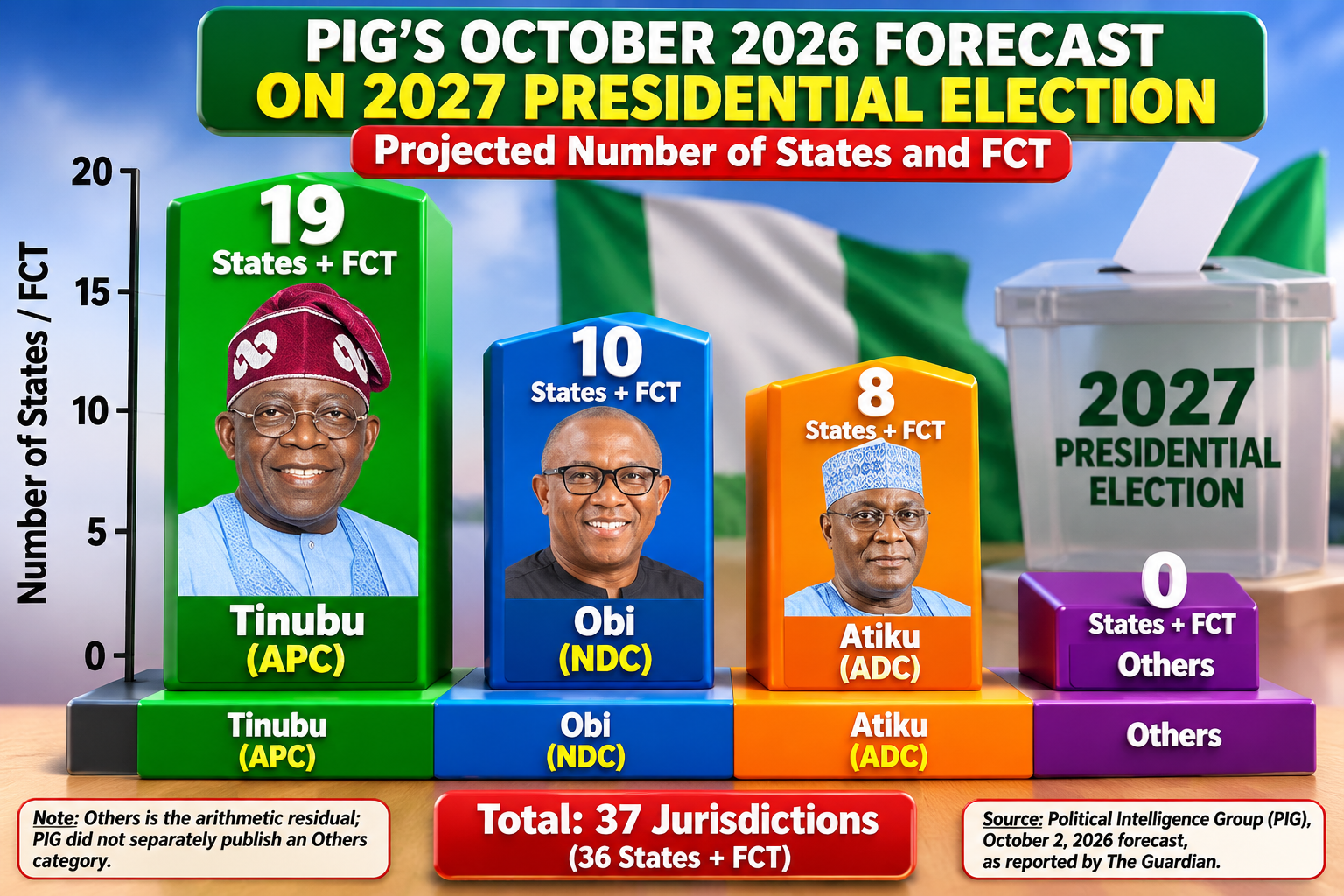
Graphical representation of PIG's Forecast
By Midwest Herald
The emerging political permutations ahead of Nigeria’s 2027 presidential election have received fresh attention following the October 2026 electoral forecast by the Political Intelligence Group (PIG), which projects a significant contest among President Bola Ahmed Tinubu of the All Progressives Congress (APC), former Vice President Atiku Abubakar of the African Democratic Congress (ADC), and former Anambra State Governor Peter Obi of the Nigeria Democratic Congress (NDC).
According to the projection, the APC is mapped to win 19 states, while Obi’s NDC is projected to secure 10 states and Atiku’s ADC eight states. The figures represent PIG’s assessment of the emerging political landscape, not actual election results or a nationally representative opinion poll.
The forecast is particularly significant because it offers a snapshot of the competing political structures, regional alliances and electoral calculations that could define the 2027 contest.
One of the important considerations in examining the projection is the APC’s position as the governing party at the federal level.
Since assuming office in May 2023, President Tinubu’s administration has pursued major economic policy changes, including the removal of the petrol subsidy and reforms to the foreign exchange market. These decisions have generated considerable debate, with supporters arguing that they are necessary to address longstanding structural weaknesses, while critics point to the immediate cost-of-living pressures experienced by households and businesses.
The political consequences of these reforms will remain central to the 2027 campaign.
For the APC, the challenge is to demonstrate measurable improvements in purchasing power, employment, infrastructure, security and the general welfare of Nigerians. The administration’s supporters are likely to make economic reforms and ongoing development projects major components of their campaign narrative.
Perhaps the most consequential feature of the emerging electoral contest is the presence of two major opposition platforms represented in PIG’s forecast by Atiku and Obi.
The ADC and NDC are projected to command substantial but separate geographical support. This raises an important question about the capacity of opposition parties to build a common political platform or coordinate their electoral strategies.
Atiku brings extensive political experience, established networks and a history of presidential contests. Obi, on the other hand, retains a distinct political following, particularly among sections of the electorate attracted to his campaign message of governance accountability, public-sector efficiency and economic restructuring.
Whether these constituencies remain separate or find common political ground could become an important consideration in the final electoral calculations.
However, it would be premature to assume that separate party projections automatically translate into transferable votes or that opposition supporters would necessarily vote for another opposition candidate in the absence of an alliance.
PIG’s reported September projection placed the APC at 20 states, ADC at nine and NDC at eight.
Its October assessment changed the distribution to APC 19, NDC 10 and ADC eight.
The reported movement includes Rivers shifting away from the APC projection and Adamawa moving into the APC column, while the NDC’s projected state count increased.
These changes illustrate the fluidity of electoral assessments and the importance of sustained political engagement across the country’s different regions.
They also demonstrate why state-level projections should be treated as indicative political assessments rather than definitive measures of presidential voting intentions.
The northern political landscape will be particularly important in the coming election.
Atiku’s political background and established northern connections, Obi’s appeal among sections of the electorate, and Tinubu’s relationships with political stakeholders across the region will all feature in the contest.
The APC will need to demonstrate that its political support extends beyond existing party structures, while the opposition parties will face the task of translating their regional followings into broader national coalitions.
The political dynamics in states such as Kano, Kaduna, Katsina, Sokoto, Kebbi, Adamawa, Borno and Niger could therefore attract considerable attention as the election approaches.
The South will also be a significant theatre of political competition.
In the Southwest, Tinubu’s political roots and the APC’s established party organisation will remain important elements of the campaign. However, voter assessments of economic conditions, public infrastructure and governance will also influence the political conversation.
In the Southeast, Obi’s political following makes the region an important area of attention for the NDC, while the APC will have to demonstrate the extent of its political reach.
The South-South presents another complex political environment, where party loyalties, federal relationships, state-level political structures and local issues will intersect.
In Edo State, the APC’s political organisation under Governor Monday Okpebholo and the state party leadership will be part of the broader national mobilisation conversation.
Beyond party structures and political alliances, the economy will remain one of the most important determinants of public debate.
Nigerians will want answers on inflation, food prices, petrol costs, electricity, unemployment, insecurity and the purchasing power of their incomes.
The Tinubu administration will be expected to defend its economic policies with evidence of progress and tangible improvements in living conditions.
Atiku and Obi, in turn, will be expected to explain how their proposed alternatives would address the country’s economic challenges, finance public services, attract investment and improve living standards.
The 2027 election will therefore provide an opportunity for competing political parties to present their records, policy alternatives and development priorities for public scrutiny.
The quality of party organisation, candidate selection, campaign financing, voter turnout, security, electoral credibility and the economic circumstances of Nigerians will all matter.
Ultimately, PIG’s forecast provides a useful starting point for examining the political landscape, but the decisive test will come when Nigerians exercise their constitutional right to vote in 2027.
For Tinubu, Atiku and Obi, the challenge is to convince Nigerians that their respective records, policies and leadership programmes offer credible answers to the country’s pressing challenges.
The 2027 contest is therefore not simply a battle of political structures. It is a contest of records, ideas, alliances and public confidence.