
High Interest Rates and Slow Growth
By Victor Ogiemwonyi
[email protected]
The economy is stabilizing, yet it needs to grow much faster. Our current tepid growth rate of 4.3% does not reflect our true potential, especially after the corrective reforms we have implemented.
Our current growth rate is barely outpacing our population growth rate of roughly 3%. We need double-digit growth to fix the major problems in our economy.
Double-digit expansion will accelerate job creation, boost corporate profits, and generate revenues, required for governments to fund critical social interventions and raise GDP per capita.
In short, it is the surest way to improve living standards for the majority of our people and lift millions out of poverty.
The Macroeconomic Trap
Today, the cost of accessing credit is far too high to deliver the growth we need. High interest rates, inflation, and sluggish growth are locked in a difficult cycle.
High borrowing costs feed into production expenses and keep inflation elevated, while elevated inflation prevents interest rates from coming down, choking off economic expansion. These are fundamental macroeconomic conflicts, natural to any developing economy.
The key levers the government can manage are interest rates, foreign exchange rates, and inflation. Because there are no one-size-fits-all solutions, we must tailor our policy response to our specific circumstances.
While inflation is receding, inflation is still too high .
At 14.06%, the current inflation rate, still needs to drop below 10% to become truly growth-friendly. Yet interest rates remain elevated because inflation is still high, and growth continues to suffer from this Catch-22.
Structural Friction in the Banking Sector
The root cause of our high interest rates lies in our structural inefficiencies.
Our banks face steep high operating expenses, due to expensive energy and poor infrastructure, which directly compress profit margins.
Consequently, banks issue too few loans because the broader business environment is not pro-growth. High operating costs leave too few viable businesses, capable of servicing expensive debt.
At the same time, the average bank customer, deterred by punitive interest rates, is restricted to small borrowings that limit business expansion. Ultimately, the government also loses out on tax revenues a faster-growing economy would generate.
Because this is a structural problem, it demands a structural solution. We must pull every available lever to achieve lower inflation, lower interest rates, and faster, broader economic growth.
A Coordinated Monetary and Fiscal Solution
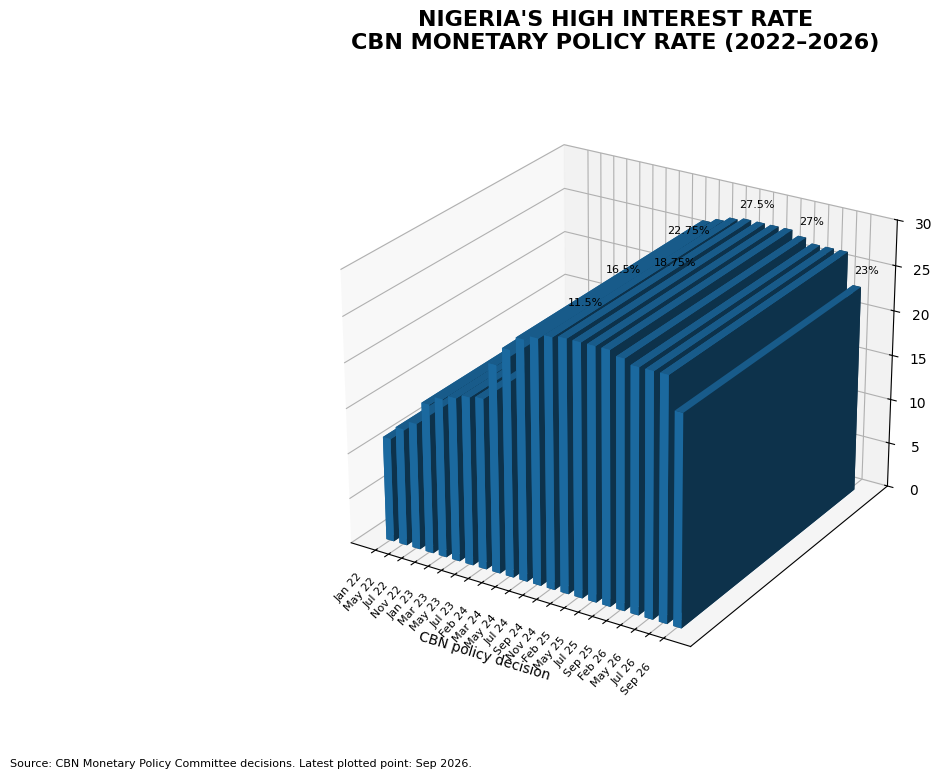
I suggest starting with the monetary authority. The Central Bank of Nigeria (CBN) should commit to cutting its Monetary Policy Rate (MPR) by 2.5% over the next five Monetary Policy Committee (MPC) meetings, delivering a deliberate 0.50% cut at each meeting. This clear forward guidance will signal the CBN’s direction and allow the market to adjust smoothly.
This gradual approach gives savers and investors time to rebalance their portfolios without disrupting the financial system. Foreign and domestic investors who came in, for high yields, will remain engaged, while accepting that the super-profits and carry-trade opportunities of the past are gradually fading, as economic efficiency improves.
On the fiscal side, the federal government should complement these rate cuts by offering a 2.5% taxable income discount to banks that grow their lending to the productive sector by at least 10% over the preceding year.
Because this discount flows directly to a bank’s bottom line, it creates a powerful incentive for lenders to aggressively expand their loan books.
Together, gradual MPR cuts and targeted fiscal incentives will help ease cost-push inflation and potentially add up to 5% to our GDP growth.
As banks build larger, more profitable loan books, the resulting economic expansion and higher corporate tax receipts will more than pay for the tax discount granted to the banks. Larger, sustained credit flows to the productive sector will anchor long-term growth.
Smart Credit Creation: Lessons from NAL Merchant Bank
Of course, rules matter: policymakers must strictly define what qualifies as the “productive sector” to ensure this new credit reaches real value creators. It should be noted that, expanding loan books, is not a license for reckless lending; banks must maintain rigorous credit management.
Creating a profitable, high-impact loan book is entirely possible when done smartly.
Two examples from my time at NAL Merchant Bank illustrate this well. NAL was widely recognized across the industry for both its profitability and the superior credit quality of its loan book.
Creative Rate Structuring
During the Abacha military administration, the government imposed a 21% interest rate cap on loans in response to soaring market rates, which had pushed interbank rates above 40%. The “brain trust” at NAL
( a collection of some of the most intelligent Bankers at the time ) devised an innovative structure that worked for the bank, the customer, and the government alike.
When a customer requested a ₦10 million loan, NAL granted a ₦20 million facility: ₦10 million was disbursed as a loan at 21%, while the remaining ₦10 million was placed in an interest-bearing deposit account at 10%, tied to the loan. The net interest cost to the customer worked out to an effective rate of 11%, keeping the facility affordable while preserving the bank’s spread and liquidity.
Value-Chain, Sectoral Lending
Again, while upholding strict credit standards, NAL met CBN mandated sectoral lending quotas for agriculture, SMEs, and housing.
For SME Lending. NAL, Created A Customer.
TripleGee & Company Plc,
now listed on the Nigerian Exchange (NGX), was built around an experienced management team using a lease arrangement for its major assets, alongside a revolving working-capital facility. This structure enabled the business to operate, expand, and reliably repay its loans.
NAL literally created this business to meet its SME sector quota.
Affcot and Its Agribusiness Off-Take Model
Affcot, an agribusiness venture sponsored by textile giant Afprint—already a customer of NAL—was enabled to fulfill agricultural lending mandates at scale. Affcot organized rural farmers into cooperatives, providing farmland and essential inputs to grow cotton, while Afprint served as a guaranteed off-taker for the entire harvest.
The enterprise created rural employment, boosted agricultural output, and supplied critical raw materials for local textile manufacturing.
This was productive lending and a genuine win-win for the economy.
Simply put, where there is a will, there is always a way.
Nigeria’s economic conditions are ripe for this kind of innovative thinking once again. With the right monetary and fiscal incentives in place, we can unlock credit and build an economy that works for everyone.