
Wike, APC Governors Showdown: ‘Errand Boy’ Row, Rainbow Coalition and The Politics of 2031
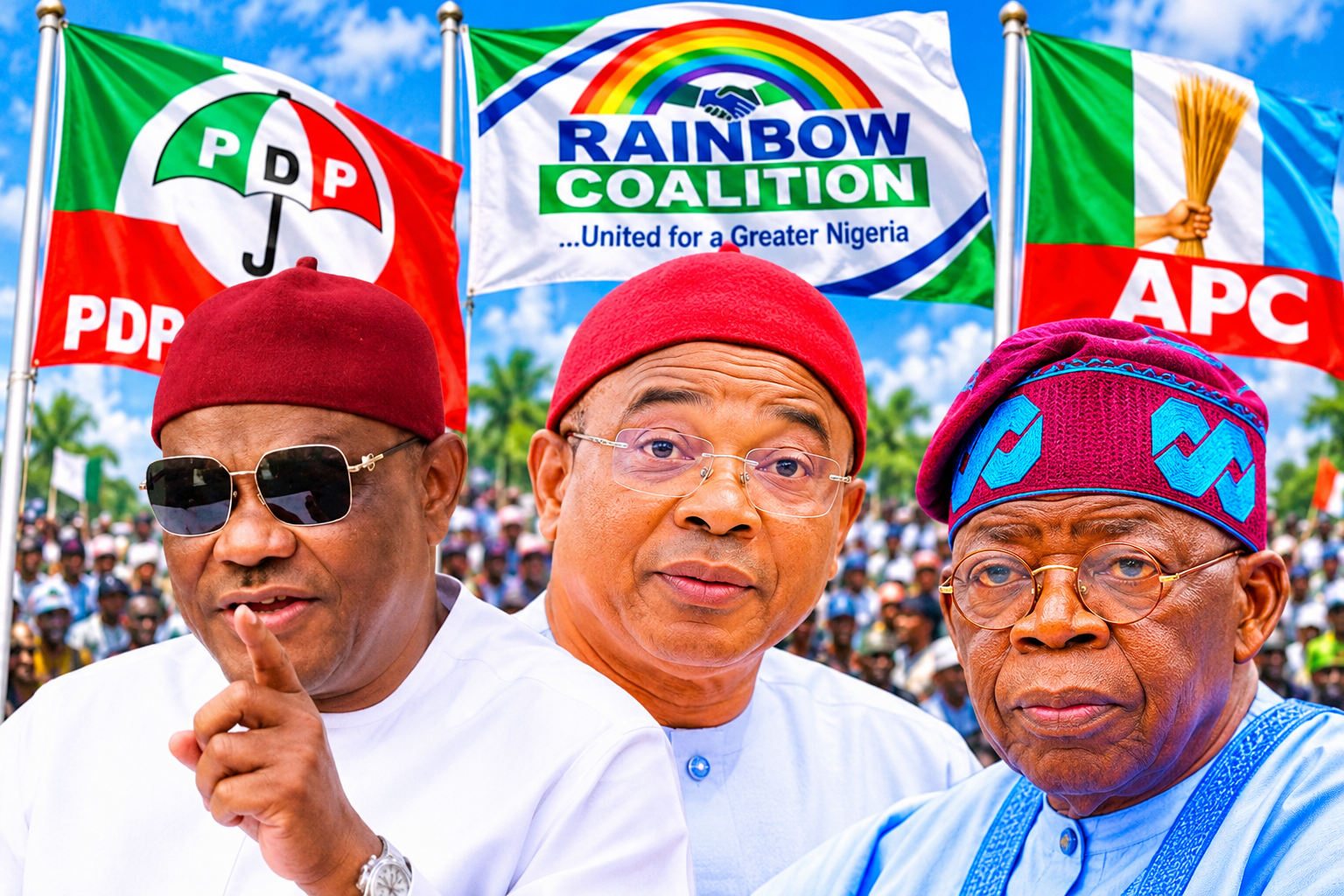
Wike-Uzodinma-Tinubu
By Editor
The unfolding political confrontation surrounding the 2027 re-election ambition of President Bola Ahmed Tinubu is beginning to expose an emerging struggle for influence within the All Progressives Congress (APC), with Minister of the Federal Capital Territory, Nyesom Wike, increasingly at the centre of the controversy.
Wike’s recent declaration that he is ready to take responsibility for delivering Imo and Kwara States to President Tinubu has opened another front in the political contest over who should control the mobilisation machinery of the ruling party ahead of the 2027 general election.
What appears on the surface to be an offer of political assistance has provoked an angry reaction from the Imo APC, raising fundamental questions about the relationship between Wike, APC governors, established party structures and President Tinubu’s re-election campaign.
At the heart of the controversy is a sensitive political question: how much room should a prominent opposition-party politician, serving in an APC-led federal government, have to influence the internal political affairs of the ruling party?
At a Rainbow Coalition Town Hall meeting in Gokana Local Government Area of Rivers State, Wike announced that he had effectively completed his political mobilisation assignment in Rivers State and the Federal Capital Territory.
He subsequently appealed to President Tinubu and the Director-General of the APC Presidential Campaign Council, Senator Abdul’aziz Abubakar Yari, to assign him two additional states — Imo and Kwara — to coordinate political activities in preparation for the 2027 presidential election.
His request was particularly significant because both states have established APC political structures and sitting APC governors.
Wike explained that he was interested in Imo because of reports of political challenges within the state, while his interest in Kwara was informed by reports of divisions in its political structure.
Although he acknowledged that he had not independently verified the situation in Kwara, his offer to intervene in both states has introduced a new dimension to the debate over political coordination within the APC.
For Wike, the proposal appears to be an extension of his ambition to demonstrate that his political influence goes beyond Rivers State and the FCT. For the APC leadership in Imo, however, the suggestion amounts to an unwelcome attempt by an outsider to insert himself into the party’s internal affairs.
The disagreement between Wike and Hope Uzodimma is, however, much deeper than the minister’s latest request to be assigned Imo State.
Uzodimma occupies a strategic position in the APC as chairman of the Progressive Governors’ Forum (PGF), giving him a central role in articulating the collective political interests of APC governors.
His opposition to Wike’s Rainbow Coalition is rooted in the argument that the President’s re-election cannot be separated from the electoral fortunes of APC candidates contesting governorship, senatorial and House of Representatives elections.
At a meeting of APC governors in Abuja in September, Uzodimma made it clear that the governors would not support any political arrangement capable of weakening the party or undermining its candidates.
Although he did not initially name Wike, his position was widely interpreted as a direct response to the minister’s coalition.
Wike subsequently responded by questioning the political motives of the governors, particularly Uzodimma and Kwara State Governor AbdulRahman AbdulRazaq.
In an interview, he alleged that some governors were more interested in controlling the political space and securing their own future ambitions than in genuinely working for Tinubu’s re-election.
He also accused Uzodimma of positioning himself for the Senate presidency after leaving office as governor, an allegation that underscores the extent to which the disagreement has moved beyond campaign organisation into the politics of future national offices.
Wike was categorical about his opposition to the Imo governor’s alleged ambition, declaring that he would not support him for Senate President.
Uzodimma has not publicly confirmed the alleged ambition as presented by Wike. Consequently, the Senate presidency issue remains an allegation and political interpretation advanced by the FCT minister.
The Rainbow Coalition is arguably the most contentious element of the emerging confrontation.
Wike’s political proposition is that politicians from different parties can unite behind Tinubu’s presidential ambition without surrendering their identities or abandoning their candidates in other elections.
Under this arrangement, a PDP politician could support Tinubu for president while campaigning for a PDP governorship or senatorial candidate.
Wike has repeatedly defended this position, drawing parallels with the political arrangement adopted by the G5 governors during the 2023 presidential election.
The APC governors, however, see a fundamental contradiction in this arrangement.
Their argument is that a political organisation campaigning for Tinubu while simultaneously supporting candidates contesting against APC candidates could weaken the party’s electoral structures at state and constituency levels.
The dispute is therefore not necessarily about whether Wike supports Tinubu. It is about the political consequences of allowing him to build an independent mobilisation structure outside the APC while retaining the freedom to support candidates who may challenge the ruling party.
In September, the Progressive Governors’ Forum formally distanced itself from any alliance capable of undermining APC candidates.
The governors’ position effectively challenged Wike’s attempt to establish a parallel political machinery for the President’s re-election.
The controversy has also exposed a fundamental difference in political philosophy: Wike believes presidential support can be separated from party loyalty in other elections, while the APC governors insist that the party must operate as a unified electoral platform.
The confrontation became particularly pronounced in Imo State, where Wike’s political activities have attracted an unmistakable response from the governor and the state APC leadership.
On October 27, Uzodimma declared that there was no Rainbow Coalition Movement in Imo State.
Speaking at the flag-off of the PBAT Door-to-Door Movement and the distribution of campaign vehicles in Owerri, the governor maintained that the APC would win the 2027 elections across all elective positions in the state.
The declaration was significant because it represented a direct rejection of the possibility of Wike establishing an alternative political platform in a state governed by the APC.
Uzodimma’s position is consistent with his responsibility as chairman of the Progressive Governors’ Forum and his insistence that APC governors must protect the party’s candidates at every level.
Wike, on the other hand, has accused Uzodimma of opposing the Rainbow Coalition because of concerns about its implications for his political interests, including his alleged ambition to become Senate President.
The minister has also alleged that the governors are uncomfortable with politicians who, after failing to secure APC tickets, obtained tickets from the PDP and other platforms and could challenge candidates favoured by the governors.
This allegation suggests that the conflict is also connected to the struggle over the distribution of political tickets, legislative influence and control of party structures.
For Uzodimma, permitting a parallel coalition to operate in Imo could create competing centres of political authority ahead of the election. For Wike, denying the coalition access would amount to restricting the political space available to those willing to support Tinubu without necessarily supporting every APC candidate.
The Imo governor’s position has therefore turned the state into one of the most visible theatres of the disagreement.
The Imo APC’s reaction to Wike’s latest offer to deliver the state for Tinubu further illustrates the depth of the disagreement.
In a statement issued by the party’s Publicity Secretary, Onwuasoanya Jones, the APC dismissed Wike as a “politically displaced errand boy” and insisted that the party had no internal crisis requiring his intervention.
The party maintained that its mobilisation activities for Tinubu’s re-election were progressing smoothly and that victory was assured.
Jones accused Wike of attempting to portray President Tinubu as politically unpopular and dependent on the services of a PDP politician to secure victory in Imo.
He also questioned Wike’s declaration that Rivers and the FCT had already been politically secured for the President, arguing that such claims were dismissive of democratic principles and the electorate’s right to determine electoral outcomes.
More significantly, the Imo APC spokesperson alleged that Wike had deployed emissaries and political agents to the state with money in an attempt to create divisions within the party.
The allegation has not been independently established. Nevertheless, the language adopted by the state APC indicates that Wike’s proposed intervention is being viewed not as an additional contribution to Tinubu’s campaign but as a potential challenge to the authority of the existing party leadership.
The APC’s response also raises an important question about the relationship between Wike and the ruling party: can a politician who remains in the PDP be permitted to organise a parallel political structure in APC-controlled states while claiming to be working for the President?
Beyond Imo, Kwara State represents another significant dimension of the dispute.
Governor AbdulRahman AbdulRazaq, like Uzodimma, has been identified by Wike as one of the governors opposed to his political activities.
Wike has alleged that the governor and other APC political stakeholders are uncomfortable with the Rainbow Coalition because of its potential impact on their control of the state’s political structure.
The minister has particularly drawn attention to the Saraki political dynasty and the emergence of politicians who, having failed to secure APC tickets, are seeking electoral opportunities on other platforms.
The disagreement is therefore also connected to the struggle over who controls political representation in Kwara and whether Wike’s coalition can accommodate politicians whose interests conflict with those of the incumbent APC leadership.
Wike’s request to be assigned Kwara, despite acknowledging that he had not independently verified reports of divisions in the state, has further complicated the situation.
For AbdulRazaq, the issue is not simply about delivering the presidential vote but also about protecting APC candidates and the party’s political influence in the state.
The Wike-Uzodimma disagreement has gradually evolved into a broader confrontation involving different political interests within the APC governors’ family.
Reports have identified some governors as sympathetic to Wike’s political arrangement, while others align with Uzodimma and AbdulRazaq in opposing the Rainbow Coalition.
The September 24 report by Vanguard described the APC governors as divided into rival camps, with some awaiting President Tinubu’s intervention before taking a definitive position.
The Guardian also reported that the disagreement had generated unease among party stakeholders, particularly over Wike’s ability to support Tinubu while backing politicians contesting against APC candidates.
The controversy is not merely a disagreement over campaign methods. It reflects competing interests over political influence, candidate selection, legislative leadership and the future configuration of power after the 2027 elections.
Wike’s critics believe that his arrangement could weaken the APC by creating a presidential campaign structure that operates independently of the party’s established machinery.
His supporters, on the other hand, can argue that Tinubu’s re-election requires support beyond the APC and that political alliances should not necessarily be restricted by party boundaries.
Both arguments expose the challenge confronting a ruling party that seeks to accommodate political allies outside its membership without undermining its own candidates.
Ultimately, the dispute places President Tinubu in a difficult political position.
Wike remains an important political ally whose support contributed to Tinubu’s electoral coalition in 2023. His political network in Rivers and his influence among politicians outside the APC are considerations that the Presidency cannot simply dismiss.
At the same time, the APC governors constitute a critical component of the President’s political machinery. They control state-level party structures, exercise considerable influence over candidate selection and are expected to mobilise support for the party across the country.
Alienating either side could generate complications for the President’s re-election campaign.
The question is whether Tinubu will allow Wike’s Rainbow Coalition to operate as an independent presidential support platform or insist that all political mobilisation in APC-controlled states must be coordinated with the party’s governors and recognised structures.
The Presidency’s ability to reconcile these competing interests could determine how the APC approaches its campaign organisation in the months ahead.
Beneath the immediate confrontation over Tinubu’s re-election is another layer of political calculation: the succession struggle that could follow the 2027 elections.
Wike has publicly accused Uzodimma of nursing an ambition to become Senate President, an allegation the Imo governor has not publicly confirmed in the reports examined.
The minister’s opposition to such an ambition has introduced another dimension to their disagreement.
There have also been media reports suggesting that the rivalry involves longer-term political calculations, including possible ambitions for national leadership positions in 2031. Such reports should, however, be treated as political speculation rather than established commitments by the individuals concerned.
What is becoming increasingly evident is that the struggle is not confined to who delivers the highest presidential votes in 2027. It is also about who controls the political structures, determines the candidates and commands influence in the post-election arrangement.
For Uzodimma, his leadership of the Progressive Governors’ Forum places him at the centre of the governors’ collective resistance to political arrangements they consider detrimental to the APC.
For Wike, the Rainbow Coalition provides an avenue to maintain political relevance beyond the PDP’s internal structures while advancing his support for Tinubu.
The unfolding confrontation presents the APC with a political dilemma that cannot be resolved by exchanging accusations or issuing statements.
Wike’s latest offer to deliver Imo and Kwara has been rejected, at least politically, by the Imo APC leadership. Uzodimma has also made it clear that the Rainbow Coalition will not be allowed to operate as an alternative political structure in Imo.
The minister, however, has shown little indication that he intends to abandon his political arrangement or surrender his freedom to support candidates outside the APC.
The bigger question is whether President Tinubu will establish a common political framework that accommodates Wike’s presidential support while protecting the interests of APC governors and their candidates.
The 2027 election is approaching, and the ruling party must contend with the reality that a coalition designed to strengthen its presidential candidate could simultaneously create disagreements over its other candidates.
For now, the Wike-Uzodimma confrontation has become a defining test of the relationship between political allies, party loyalty and the distribution of power within the Tinubu political establishment.
The central battle is no longer simply about who supports Tinubu. It is about who controls the machinery of that support, who determines the political beneficiaries and who ultimately calls the shots in the emerging 2027 electoral arrangement.