
Edo House is Not For Sale: An Open Letter to Governor Monday Okpebholo on The Proposed Disposal of Edo State’s Historic Lagos Property
By Dr. Pedro Obaseki
Your Excellency,
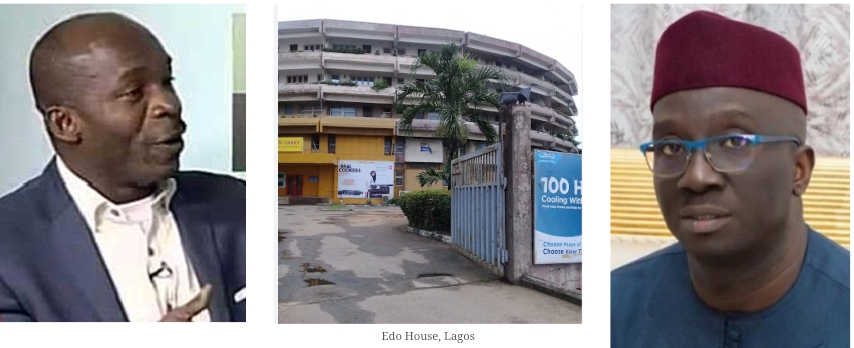
Recent reports suggesting that the Edo State Government may be considering the sale, concession, or transfer of Edo House located at 1225 Ahmadu Bello Way, Victoria Island, Lagos, have understandably generated widespread concern, public protests, and intense public scrutiny among Edo people both at home and across the diaspora.
What began as speculation has now evolved into a matter of grave public importance following growing interventions from respected citizens and elder statesmen, including the recent open appeal by former Senator Ehigie Uzamere, who urged your administration to reconsider any move capable of permanently alienating one of the most strategic assets ever owned by Edo State outside its territorial boundaries.
ike many concerned Edo sons and daughters, I consider it necessary to add my voice.
This intervention is not motivated by partisan hostility, personal resentment, or political opportunism.
It is rooted in a sincere conviction that Edo House represents far more than a mere property transaction.
It is a historic public inheritance — a symbol of continuity, foresight, institutional presence, and intergenerational wealth belonging not to any government in office, but to the people of Edo State across time.
Edo House is one of the most strategically located public assets in Nigeria.
Situated in the heart of Victoria Island, Lagos — Nigeria’s commercial nerve centre — the property occupies a prime corridor whose economic value continues to appreciate exponentially.
Estimates already place the property’s worth in the region of hundreds of millions, if not close to a billion United States dollars.
To dispose of such a property under present economic realities would amount, in the eyes of many citizens, to mortgaging the future of Edo State for temporary political or financial considerations.
The fundamental question therefore is this: Why should Edo State sell an asset capable of becoming one of its greatest long-term revenue generators?
Globally, visionary governments do not liquidate premium strategic assets merely because they possess immediate resale value. Rather, they optimize them.
They modernize them. They restructure them into recurring income-generating institutions capable of sustaining future generations.
Edo House possesses enormous untapped economic potential.
With proper redevelopment, professional asset management, and transparent commercial restructuring, the property could become:
a major hospitality and business hub;
a corporate and diplomatic liaison complex;
a technology and investment centre;
a premium commercial leasing asset;
or a permanent independent revenue stream for Edo State.
In an era when subnational governments across Nigeria are desperately searching for sustainable internally generated revenue, selling a premium asset of this magnitude would appear economically counterproductive and historically shortsighted.
More importantly, certain assets transcend mere commercial valuation.
Edo House is one of the few enduring symbols of Edo State’s institutional identity outside Benin City. It is part of the historic inheritance transferred from the old Bendel State era — a legacy connected to an age of visionary public-sector thinking and long-term state-building.
Once sold, such assets are almost impossible to recover.
Nigeria’s history is filled with painful examples of strategic public properties sold under controversial circumstances, only for future generations to lament the irreversible loss of collective wealth. Governments come and go, but public inheritance belongs equally to the unborn.
This is precisely why the growing public anxiety surrounding Edo House must not be dismissed as mere political noise.
Citizens are worried because public trust across Nigeria has repeatedly been damaged by opaque privatization exercises in which highly valuable government assets eventually found their way into private hands through politically connected arrangements.
Whether such fears are justified in this instance or not, perception itself matters greatly in democratic governance.
Transparency therefore becomes imperative.
If there are indeed plans involving Edo House, Edo people deserve full disclosure. They deserve open consultation.
They deserve legislative oversight. They deserve independent valuation processes. And above all, they deserve reassurance that no irreversible decision concerning a strategic public inheritance will be taken without broad public scrutiny.
Your Excellency, leadership is ultimately measured not only by projects initiated, but also by legacies preserved.
Political power is temporary. Stewardship of public inheritance is permanent.
History remembers leaders in two distinct ways: those who expanded public inheritance, and those under whose watch collective assets disappeared.
At moments like this, restraint can become statesmanship.
This intervention should therefore be understood as an appeal to conscience rather than an act of hostility.
I respectfully urge your administration to publicly clarify the status of Edo House and reassure Edo people that no secretive or non-transparent process aimed at alienating this strategic property will be undertaken.
If redevelopment is necessary, let redevelopment occur.
If modernization is required, let modernization occur.
If commercial optimization is needed, let competent professionals handle it transparently.
But ownership must remain with the people of Edo State.
Future generations may never forgive the unnecessary disposal of a heritage asset whose value — both economic and symbolic — will continue to multiply with time.
Some inheritances are too important to sell.
Edo House is one of them.
History is watching.
And posterity will remember.
Dr. Pedro Obaseki, writes from Benin City, Edo State