
Amaechi is The ‘Madman’: Edo People Charge ADC Running Mate, Call for Insanity Test
Ameachi
By Arit Mbeh
BENIN CITY — Electorates in Edo State are calling for the Federal Ministry of Health to forcibly remove carry the former Rivers State Governor Rotimi Amaechi from the streets and carry out psychiatric evaluation and treatment on him. The urgent call is as a result of the clueless provocative statement here recently made in Benin City.
The Vice Presidential candidate of the African Demcratic Congress ADC) has come under criticism over his declaration that only a “mad man” would vote for President Bola Ahmed Tinubu in the 2027 presidential election, raising questions about his political tolerance, democratic rights and the growing tendency among politicians to insult citizens who disagree with them.
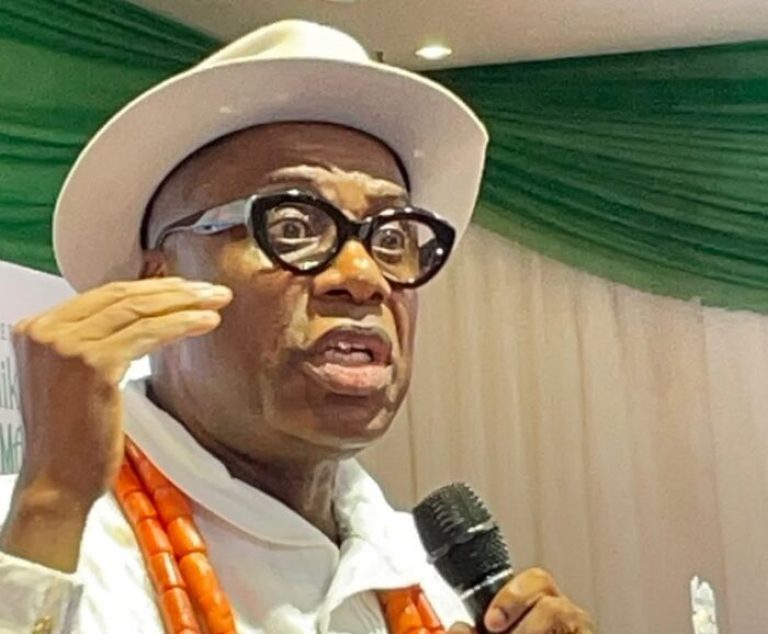
Amaechi, the vice-presidential candidate of the African Democratic Congress (ADC), made the controversial statement on Thursday, October 8, 2026, at an ADC town hall meeting in Benin City, Edo State, where he urged residents to reject Tinubu in next year’s election.
“They are going about saying, vote Tinubu, vote Tinubu; only thieves will vote for Tinubu,” Amaechi said.
He added: “In fact, I read on social media that it is in 2027 that we will know how many mad men we have in Nigeria because it is only a mad man that can vote for Tinubu.”
The former governor went further, declaring that if Edo people voted for Tinubu, it would mean they were “mad,” insisting that the President should not win in the state.
But Amaechi’s sweeping generalisation raises a fundamental question: who appointed him the arbiter of the mental condition, intelligence and political judgment of millions of Nigerians who may choose to vote differently from him?
In a democracy, a citizen’s right to vote for a candidate is not determined by the approval of an opposition politician. Nigerians are free to support Tinubu, Amaechi’s party or another candidate based on their convictions, political interests and assessment of the available choices.
The freedom to make political choices is a cornerstone of democratic governance. Section 40 of the 1999 Constitution, as amended, guarantees freedom of peaceful assembly and association, while the Constitution and Nigeria’s electoral framework provide the basis for citizens’ participation in the democratic process.
Amaechi is entitled to campaign against Tinubu, criticise his policies and urge Nigerians to vote for the opposition. What he cannot reasonably expect, however, is that every Nigerian must share his political conclusions.
A voter may oppose Tinubu because of economic hardship, inflation, unemployment, insecurity or dissatisfaction with government policies. Another may support the President because of his assessment of ongoing reforms, infrastructure projects or the alternatives offered by opposition parties.
Both positions are part of democratic debate. Neither automatically makes the voter mentally unsound, dishonest or unpatriotic.
By describing prospective Tinubu voters as “mad,” Amaechi substitutes insult for persuasion and risks alienating citizens whose support he may need to win an election.
If he believes Tinubu’s administration has failed, he should present evidence of those failures, explain how they have affected Nigerians and demonstrate how an ADC-led government would perform differently. The electorate deserves arguments, not abuse.
Amaechi’s remarks are particularly striking against the background of questions surrounding his own eight-year administration as governor of Rivers State, from 2007 to 2015.
While his government undertook infrastructure and other development projects, some high-profile initiatives failed to deliver the outcomes originally promised, leaving a legacy that continues to attract political criticism.
One prominent example is the Port Harcourt monorail project, conceived during his administration as a mass-transit system for the state capital.
The project was expected to improve urban transportation, but it never developed into the fully operational service originally envisaged.
In August 2015, The Guardian reported that the project’s technical partner had declared it no longer tenable after more than N33.9 billion had reportedly been spent. The project became a major subject of controversy over expenditure, planning and the failure to complete the proposed transport system.
Another disputed initiative was the Justice Adolphus Karibi-Whyte Specialist Hospital project. In October 2026, FCT Minister Nyesom Wike challenged Amaechi to account for the project, citing questions about the reported $39.2 million payment to a contractor and the facility’s failure to materialise as planned. These allegations and questions form part of a long-running political dispute and should be distinguished from any independently established finding of wrongdoing.
Wike also questioned the reported expenditure on an anti-malaria fumigation programme undertaken during Amaechi’s tenure.
These issues raise legitimate questions about project delivery, public expenditure and accountability. They are relevant to an assessment of Amaechi’s record, particularly as he seeks national leadership and criticises the performance of another administration.
The point is straightforward: just as Tinubu’s performance is open to public scrutiny, Amaechi’s own record should withstand the same examination.
Amaechi has spent years occupying influential positions in Nigerian politics, including eight years as Rivers State governor and a subsequent tenure as Minister of Transportation.
Those years provide a substantial public record against which his claims about leadership, governance and political performance can be examined.
The abandoned monorail and the controversies surrounding the specialist hospital are among the issues critics may reasonably raise when evaluating his administration.
Political leaders seeking public office should expect scrutiny of their own records before passing sweeping judgments on the intelligence or character of voters who disagree with them.
If Amaechi believes that Nigerians should reject Tinubu in 2027, he must convince them through a credible alternative programme, a clear explanation of the President’s shortcomings and evidence that the opposition can govern more effectively.
His years in public office should also form part of that conversation.
Democracy allows politicians to criticise one another, but it does not grant any politician exclusive ownership of political wisdom or the right to determine who is fit to vote for a particular candidate.
The 2027 presidential election should be about competing ideas, public records, policy choices and the future of Nigeria.
Tinubu’s supporters must be free to defend the President. His opponents must be free to challenge him. Undecided voters must be able to examine the arguments on both sides without being subjected to ridicule.
Ultimately, voters will decide whether Tinubu deserves another term, whether Amaechi and his political allies offer a credible alternative, or whether another candidate better represents their interests.
That decision belongs to Nigerians, not to any political leader.
Amaechi may campaign vigorously against Tinubu, but he should recognise that disagreement with his political position is not evidence of madness.
In a democracy, the right to choose one’s candidate is fundamental to meaningful political participation. No politician owns that right, and no politician’s insult can take it away.