
Edo Ijaw Demand Kingdom Recognition, Threaten Boundary Adjustment to Delta, Ondo
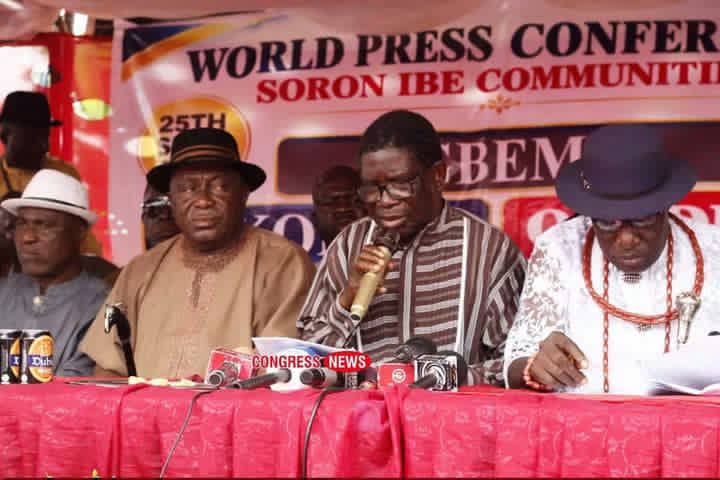
A Cross Section of Ijaw leaders during the press conference
By Reporter
BENIN CITY — The Ijaw-speaking people of Edo State have demanded immediate recognition of their five traditional kingdoms, warning that failure by the state government to address their grievances could force them to seek boundary adjustments that would enable them to join their kinsmen in neighbouring Delta and Ondo states.
The demand was made by leaders of the Furupagha, Egbema, Okomu, Gbaran and Olodiama kingdoms at a press conference in Gelegbene community, Olodiama Kingdom.
The Ijaw leaders also demanded the creation of three indigenous Ijaw Local Government Development Areas, arguing that the move would give their people a stronger political voice and accelerate development in their communities.
The renewed agitation followed the longstanding tensions between sections of the Ijaw and Bini communities in Edo, particularly the recent dispute in which, according to the Ijaw leaders, their people were repeatedly described as “tenants”, “slaves”, “captives”, “settlers” and “strangers”.
Reading a statement endorsed by representatives of the five kingdoms, High Chief Robinson Ogunkoruwei said the continued refusal to accord the Ijaw communities distinctive traditional recognition had deepened tensions and created a sense of marginalisation.
He said boundary adjustments with Delta and Ondo states, where large Ijaw populations reside, could provide an alternative if the Edo State Government continued to reject their demands.
According to him, such an arrangement would allow the Edo Ijaw to be “better assimilated and developed” while helping to prevent what he described as the persistent conflict between the Ijaw and Bini peoples.
The statement was signed by Elder Edmund Douyah Tiemo, President, Ijaws of Edo State and Chairman, Egbema Leaders of Thought; High Chief Daniel Agagha of Egbema Kingdom; Chief Edwin Deinmene of Okomu Kingdom; High Chief B.A. Amiyenkumor of Gbaran Kingdom; Chief Ben Bowei of Furupagha Kingdom; Engr. Pius Donyegha of Olodiama Kingdom; and Dr Freedom Atigbi, youth leader and immediate past Deputy National President of the Ijaw Youth Council, among others.
The leaders accused successive Edo administrations of failing to protect the interests of the Ijaw communities and alleged that the government had contributed to the political fragmentation of their people.
“For far too long, the five Ijaw Kingdoms in Edo State have been subjected to untold inhuman treatment by our neighbours, the Bini people, who are being aided and abetted by the Government of Edo State,” the statement said.
They alleged that the Ijaw communities had been “Balkanized” among different local government areas, which they claimed had weakened their collective political influence.
The leaders also accused successive administrations of attempting to annex or rename some of their communities.
They further alleged that the Palace of the Oba of Benin had repeatedly described Ijaws as tenants or people captured in wars and settled on Bini land.
The Ijaw leaders rejected the characterization, insisting that their people were indigenous to their communities and had distinct cultural, linguistic and traditional institutions.
“The Bini people met us on the land,” they declared, insisting that the Ijaws had their own language, kings and traditional institutions and had never paid allegiance to the Oba of Benin.
They demanded, among other things, the immediate recognition of the five traditional rulers of Egbema, Olodiama, Okomu, Furupagha and Gbaran kingdoms and the presentation of Staff of Office to the monarchs.
They also demanded the creation of three Ijaw Local Government Development Areas and measures they said would guarantee greater political representation and development for their communities.
The Ijaw leaders warned that the alleged “oppression, name-calling and dehumanisation” could no longer continue, calling for what they described as freedom and peaceful coexistence in their ancestral communities.
However, Edo State Commissioner for Information and Strategy, Prince Kassim Afegbua, rejected the allegation that the state government was aiding the Bini people against the Ijaws.
Afegbua told Midwest Herald that the state government would not want to “discriminate” in the matter.
“We operate a collective and homogeneous system of governance. We are deep in inclusive government where every ethnic configuration has a sense of belonging for proper integration as a state. We dont discriminate in our approach.
“The Governor carries everybody along, listens to their plight and act based on their request. We may not have all that it takes to meet all the expectations, but we are running an all inclusive government.
“The Ijaw community must be assured of our support, inclusion and cooperation. They are part of the state, we will continue to embrace them. We are working with some of their representatives in our shared commitment to take Edo to greater heights.” Afegbua said.
He stressed that, the government could not grant the demand for the creation of separate kingdoms within the Benin Kingdom.
The conflicting positions have further exposed the deep-rooted dispute over traditional authority, identity, political representation and territorial claims involving the Ijaw communities and the wider Benin traditional structure in Edo State.