
What Happened in the Garden: Psalmuela Unravels the Story of Creation, Choice, Light and Separation
Ogbemudia
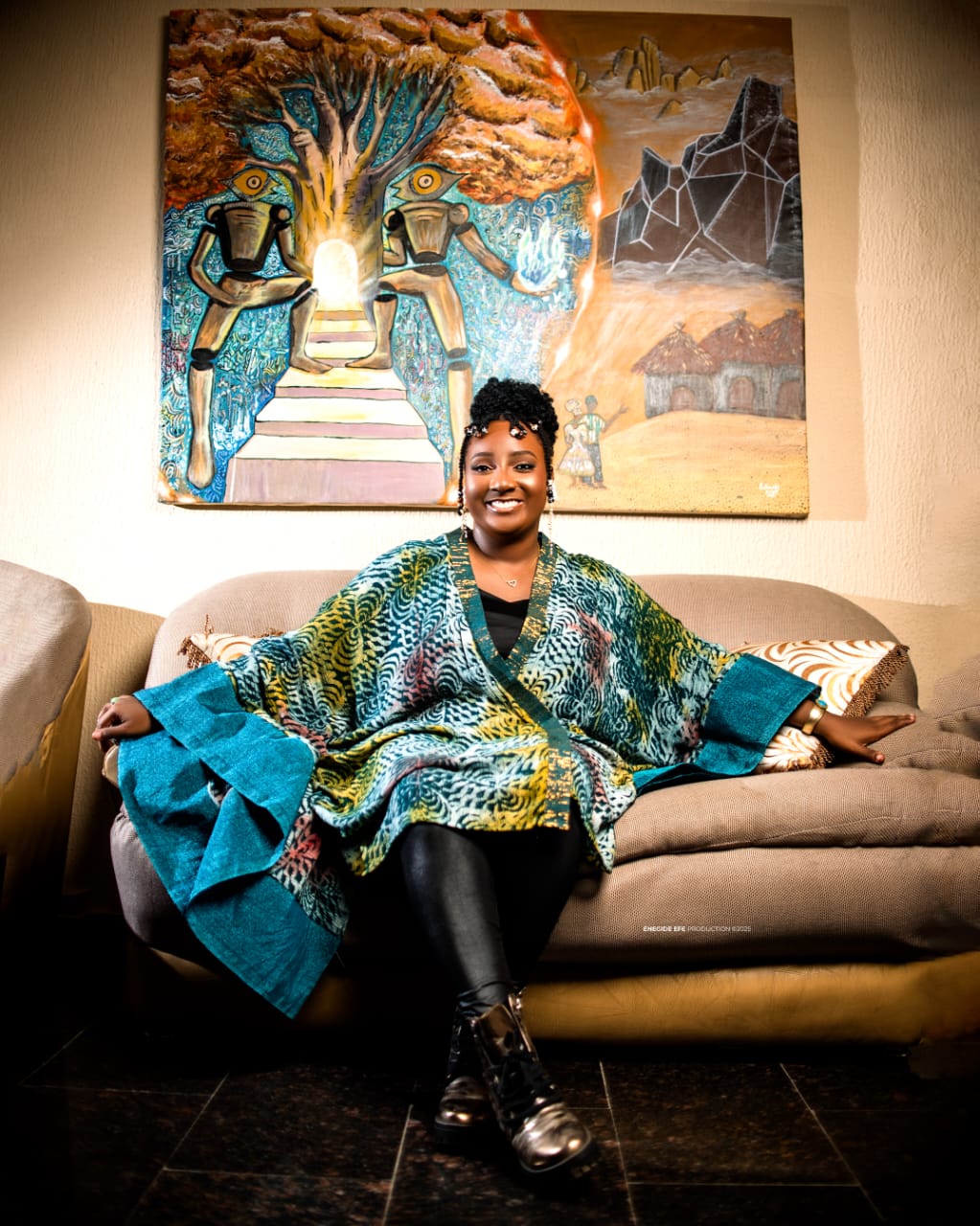
By Samuela Ogbemudia, popularly known as Psalmuela, the ‘Artistic Psalmist’, granddaughter of late Nigeria Statesman, Military and Civilian Governor of Midwest and Bendel State, Brigedier-General S. O. Ogbemudia writes for Midwest Herald
Contemporary visual artist and multidisciplinary creative Samuela Ogbemudia, known as Psalmuela, the Artistic Psalmist, is exploring the biblical story of creation, humanity and the Garden of Eden through her ongoing visual art series, What Happened in the Garden.
Rooted in the biblical account of the Garden, the series examines the events surrounding humanity’s first choices and the consequences that followed. At the same time, Psalmuela draws attention to the enduring significance of trees across ancient cultures, particularly their association with knowledge, life, ancestry, spirituality and the unseen.
Across cultures, trees have carried profound symbolic meaning. In many African traditions, trees have been treated with reverence and associated with ancestral memory, sacred spaces, traditional knowledge, harvest and spiritual encounters. Similar symbolism can be found in ancient civilizations across the world.
These cultural connections lead Psalmuela back to the biblical Garden and its two significant trees: the Tree of the Knowledge of Good and Evil and the Tree of Life.
The question at the heart of the series therefore becomes: What happened in the Garden, and what was the consequence of humanity’s choice?
Part One: Tree Choices
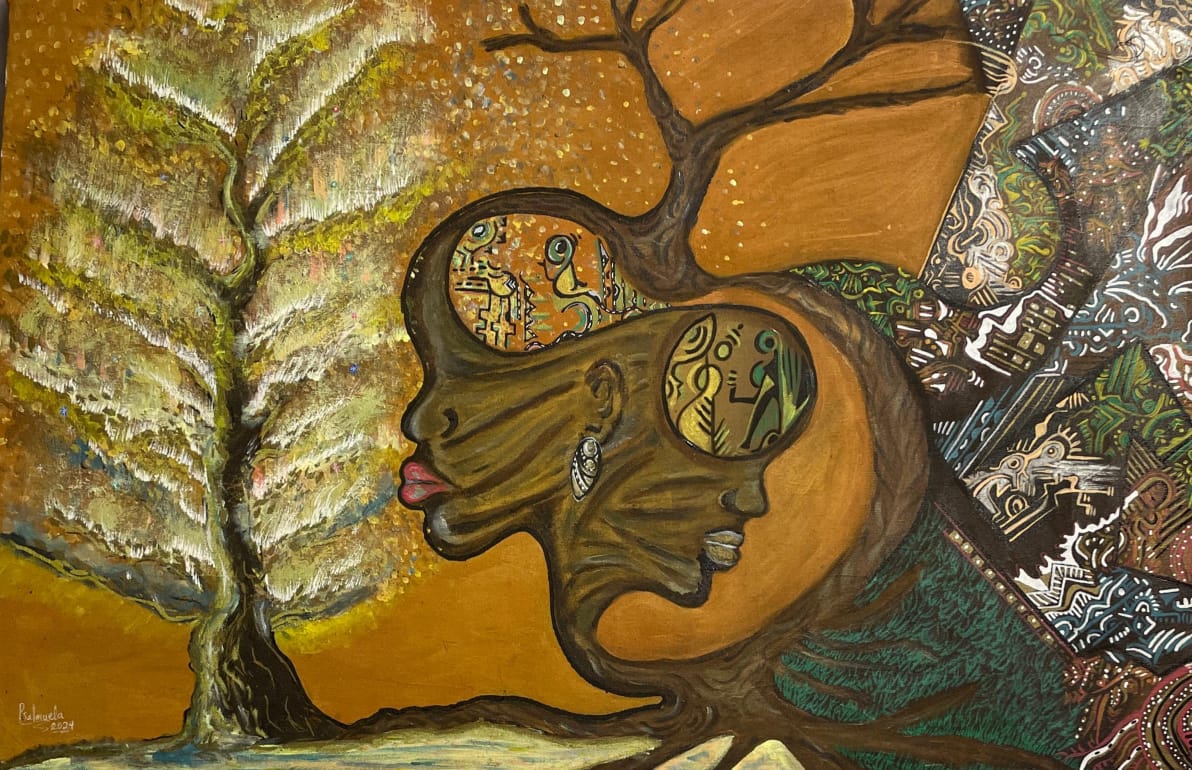
The first work, Tree Choices, introduces the two significant trees in the Garden—the Tree of the Knowledge of Good and Evil and the Tree of Life.
Rather than presenting the trees simply as symbols, the work places emphasis on the choice before humanity: which tree should be chosen?
The painting establishes the foundation of the entire series by exploring choice, obedience, knowledge, life and the consequences attached to humanity’s decision.
Part Two: Exile
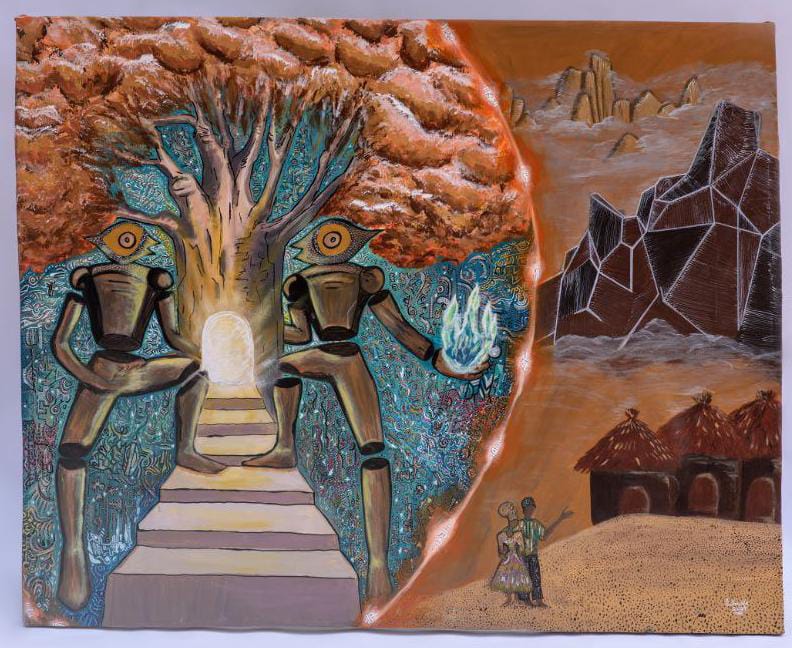
Exile follows the consequence of that choice.
The work depicts humanity’s departure from the Garden and the beginning of a new condition outside the place of divine abundance and fellowship. It explores separation, loss and the consequences of man’s disobedience, while continuing the biblical narrative established in the first work.
The Garden is no longer simply a place that humanity inhabits; it becomes a reminder of what was lost.
Part Three: The Globe Light
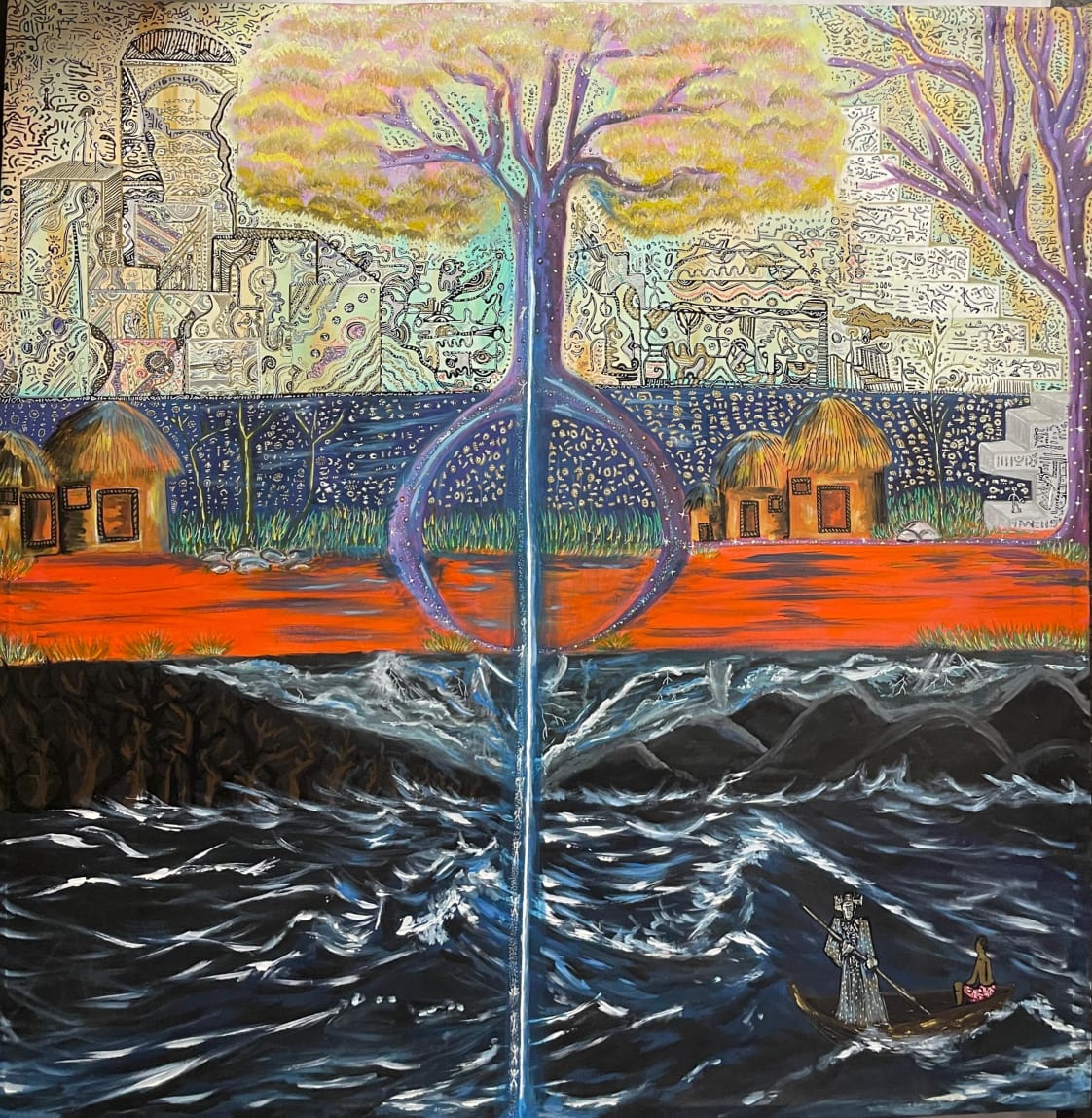
The Globe Light moves the story from the Garden into the larger story of creation.
Inspired by Genesis 1:3, where God declares, “Let there be light,” the work explores God’s light entering a world covered in darkness.
The globe is divided into three realms: the heavens, the earth and what lies beneath the earth—the sea.
Psalmuela’s interpretation also draws upon ancient Mesopotamian and African understandings of the sea as a mysterious realm associated with chaos, the gods and the dwelling place beyond ordinary human habitation. Within this ancient symbolic framework, the sea could represent a realm of the unknown and the dead.
Against this darkness, The Globe Light presents God’s light shining into the depths—a divine light that penetrates darkness and rescues souls.
The work therefore becomes a visual meditation on God’s light reaching even into places of darkness and chaos.
Part Four: When the Heavens and Earth Separated
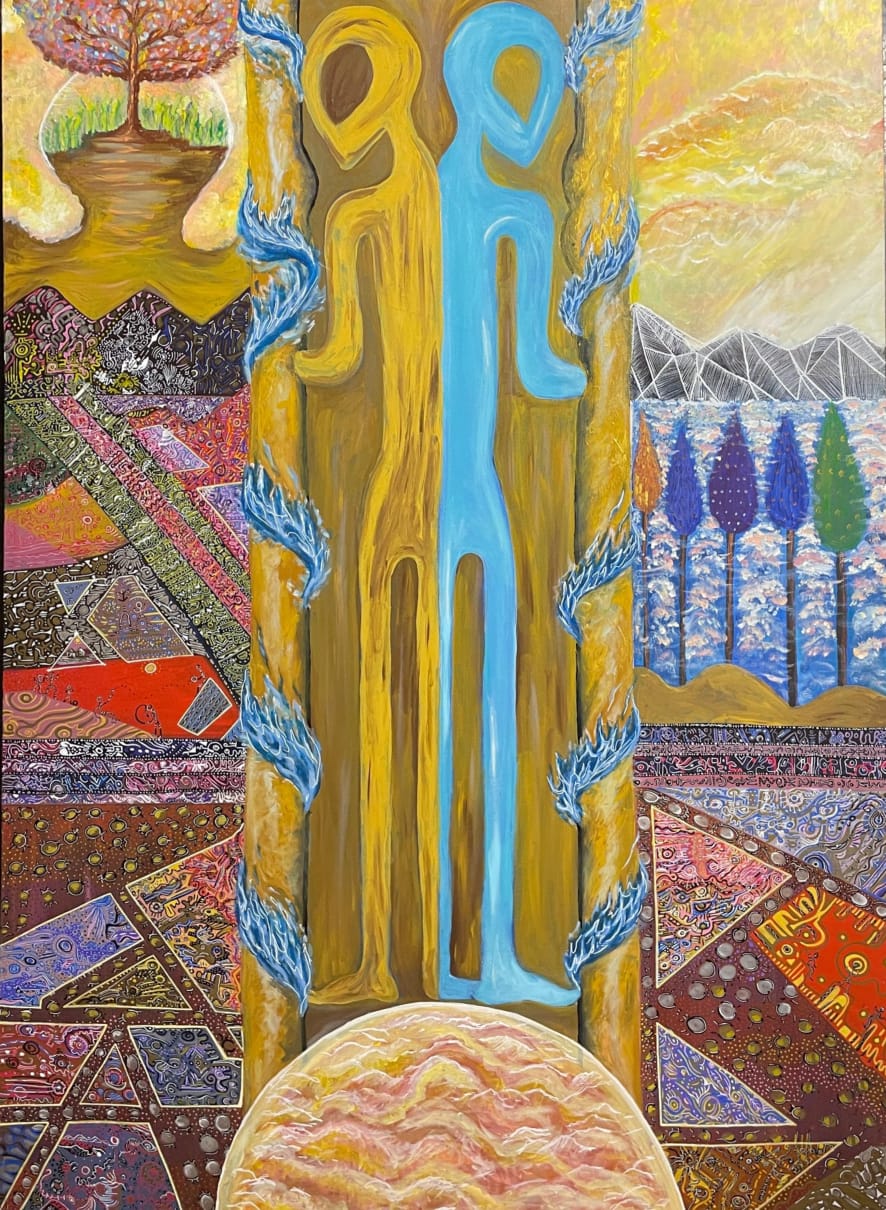
When the Heavens and Earth Separated continues the story by examining the division between the heavenly and earthly realms.
The separation is presented as a consequence of what happened in the Garden. It represents a departure from the original divine intention for heaven and earth to exist in unity.
The opening words of Genesis—“In the beginning God created the heavens and the earth”—establish the original order of creation. Psalmuela’s work reflects on what happened when that harmony was disrupted.
The separation therefore becomes more than a physical division. It represents a spiritual rupture between humanity, creation and the divine order God intended from the beginning.
Part Five: When the Night Came
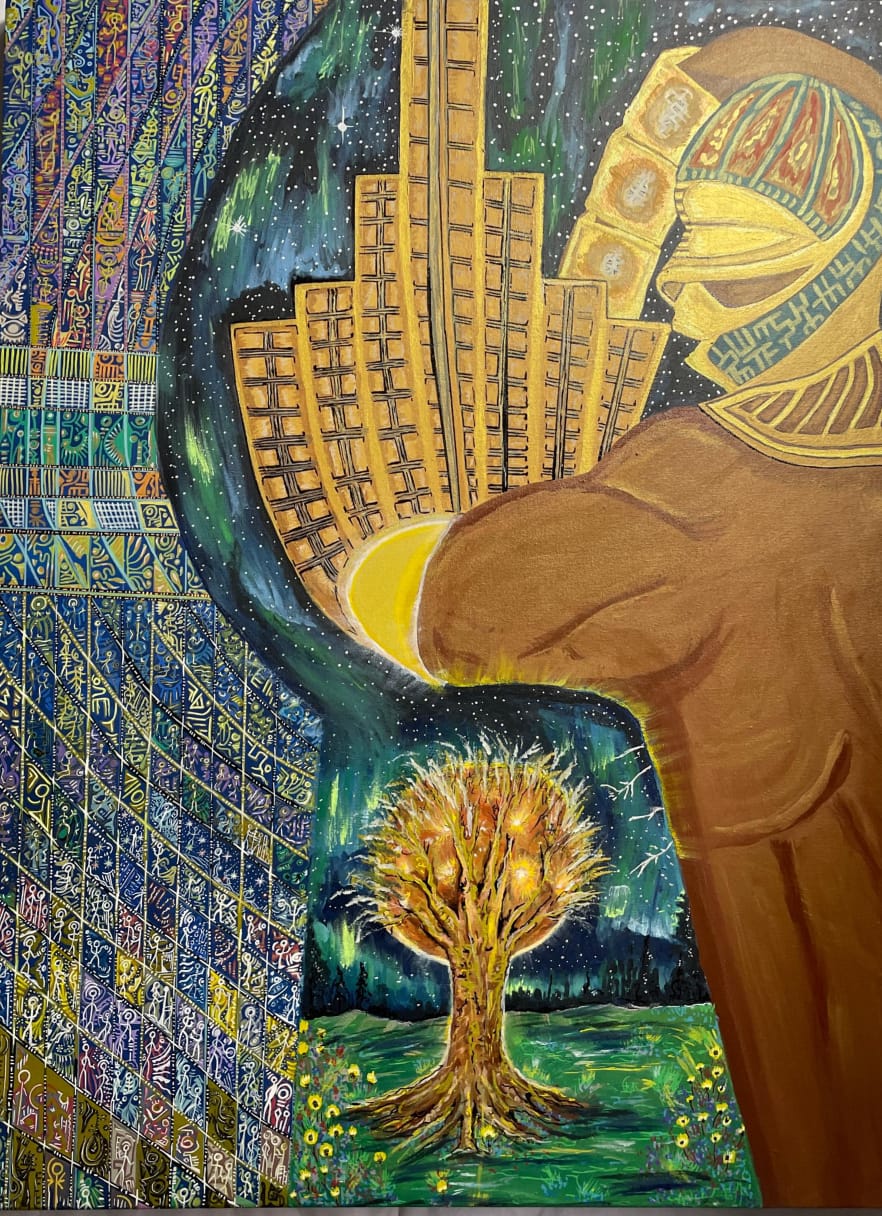
When the Night Came continues directly from When the Heavens and Earth Separated.
With the separation comes darkness.
The arrival of night becomes a visual representation of the altered condition that followed the events of the Garden. It marks another turning point in the unfolding narrative—the movement from the original order of creation into a world experiencing separation and darkness.
Yet When the Night Came is not the conclusion.
The Story Continues
What Happened in the Garden remains an ongoing project.
With five parts currently developed, Psalmuela is continuing to work on subsequent chapters that will further explore the biblical story and its implications for humanity, creation, spirituality, light, darkness, nature and the unseen.
The series forms part of Psalmuela’s wider artistic philosophy: using visual art to tell stories that connect humanity with God, creation, ancient wisdom and the mysteries of existence.
Her music carries the same underlying narrative.
As a gospel singer-songwriter, Psalmuela’s music explores what she describes as “Sounds of the Eternal Purpose”—the story of God’s original purpose, desire and plan for humanity. Her visual art seeks to communicate that same story through another language.
Where her music uses sound, melody and voice, her paintings use symbolism, colour, imagery and visual narrative.
For Psalmuela, therefore, music and visual art are not separate creative expressions. They are different forms through which she tells a connected story about God, humanity and creation.
Through What Happened in the Garden, she invites viewers to return to the beginning—to the trees, the choices, the light, the separation and the darkness—and to consider what may have been lost, what remains, and what the continuing story of humanity might ultimately reveal.
The Garden story has not ended. Psalmuela is still painting it.