
Oshiomhole Rallies Senators Revolt Against Boko Haram Amnesty, as Senate Pushes Tinubu to Scrap Rehabilitation Programme
Oshiomhole-Senate
By Arit Mbeh
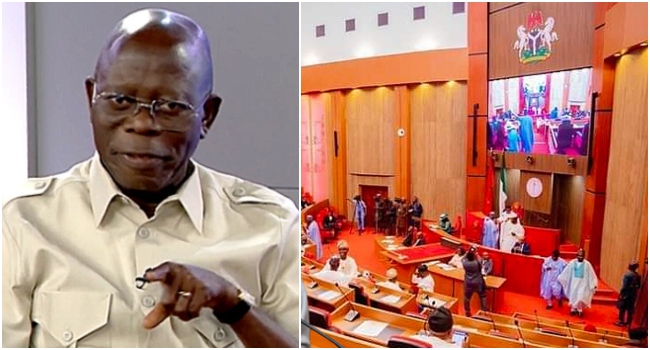
ABUJA — Senator Adams Oshiomhole on Tuesday led a fierce Senate push against the Federal Government’s controversial policy of rehabilitating and reintegrating repentant Boko Haram terrorists, declaring that the programme “does not make common sense” and urging President Bola Tinubu’s administration to end what many lawmakers described as an unacceptable concession to terrorists.
In one of the strongest parliamentary condemnations yet of the policy, the Senate overwhelmingly adopted a resolution calling on the Federal Government to abolish the rehabilitation of repentant Boko Haram members, while also resolving to send a high-powered delegation to meet President Tinubu over Nigeria’s deepening security crisis.
The dramatic intervention came as senators admitted that terrorism, banditry and kidnapping have continued to overwhelm security efforts, with lawmakers warning that armed groups have become increasingly sophisticated and audacious.
Although Senator Joseph Ikpea (Edo Central) formally introduced the additional prayer seeking the abolition of the programme, it was Oshiomhole’s forceful intervention that shaped the debate and rallied support across the chamber.
The former Edo State governor and senator representing Edo North argued that a nation battling relentless terrorist attacks cannot continue to pardon and rehabilitate those who once took up arms against it.
“It does not make common sense,” Oshiomhole declared, questioning a policy that offers rehabilitation to former insurgents while thousands of victims of terrorism continue to mourn loved ones, remain displaced and struggle to rebuild their lives.
He challenged the moral and security logic behind reintegrating former terrorists into communities that had suffered years of killings, destruction and displacement, insisting that the National Assembly should move beyond expressions of concern to legislative action.
Oshiomhole urged the Senate to consider enacting laws that would permanently abolish the rehabilitation of repentant Boko Haram terrorists, arguing that Nigeria must send an unmistakable message that terrorism attracts justice—not rehabilitation.
His remarks drew overwhelming support from lawmakers, prompting Deputy Senate President Barau Jibrin, who presided over plenary, to put the proposal to a voice vote. The chamber adopted the resolution with a resounding “aye,” signalling broad bipartisan backing for a review of one of Nigeria’s most controversial counterterrorism policies.
The Senate also approved a separate proposal by Minority Leader Abba Moro directing its leadership to constitute a delegation to meet President Tinubu on what lawmakers described as the country’s rapidly deteriorating security situation.
The meeting is expected to focus on urgent measures to confront the rising wave of terrorism, banditry and kidnapping that has continued to claim civilian and military lives across the country.
The resolutions followed a motion sponsored by Senator Abdulaziz Yar’Adua (Katsina Central), who drew attention to the recent abduction and killing of retired Major General Rabe Abubakar and other military officers by bandits.
Yar’Adua warned that terrorist and criminal networks had become more organised, technologically sophisticated and increasingly emboldened, extending attacks beyond rural communities to direct assaults on military personnel and security formations.
He called on the Federal Government to fast-track the deployment of modern military capabilities, including unmanned aerial systems, geospatial intelligence, integrated command-and-control platforms and advanced communication technologies to strengthen the fight against terrorism and banditry.
The Senate also urged its leadership to pay condolence visits to the family of the late Major General Rabe Abubakar, the Katsina State Government and the Nigerian Army.
Tuesday’s resolution places fresh political pressure on the Tinubu administration over Operation Safe Corridor, the Federal Government’s deradicalisation and reintegration programme established in 2016 for repentant Boko Haram members.
The initiative was expanded after thousands of insurgents surrendered following internal fighting between Boko Haram and the Islamic State West Africa Province (ISWAP), particularly after the death of Boko Haram leader Abubakar Shekau.
Government officials and military authorities have consistently defended the programme, arguing that rehabilitation encourages defections, weakens terrorist organisations and aligns with international Disarmament, Demobilisation and Reintegration (DDR) principles.
But critics have long maintained that the policy is insensitive to victims of insurgency and poses potential security risks, questioning whether former fighters can be safely reintegrated into communities devastated by years of terrorist violence.
While the Senate’s resolutions are not legally binding, Tuesday’s debate marked one of the clearest and most coordinated political challenges yet to the rehabilitation policy. With Oshiomhole now openly calling for legislation to abolish the programme and senators preparing to take their concerns directly to President Tinubu, the future of the controversial initiative is likely to come under renewed national scrutiny.