2026 Nigeria Prize for Literature: Poetry, Politics and the Road to 2027
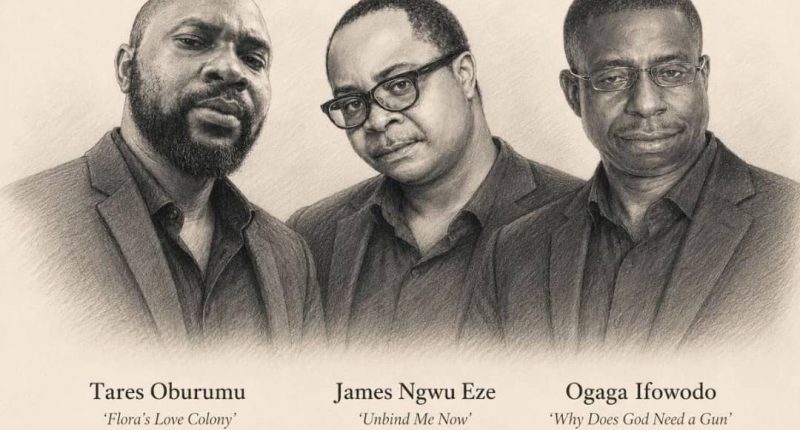
Authors shortlisted for 2026 Nigeria Price for Literature
By Prof Ikhimwin Osagiede
As Nigeria edges towards another decisive electoral season in 2027, the country’s literary establishment has, perhaps unintentionally, placed a political mirror before the nation.
The 2026 Nigeria Prize for Literature, sponsored by Nigeria LNG Limited (NLNG), is devoted to poetry. From 223 submissions, the competition has been narrowed to three collections: James Ngwu Eze’s Unbind Me Now, Ogaga Ifowodo’s Why Does God Need A Gun?, and Tares Oburumu’s Flora’s Love Colony. The winner is scheduled to be announced at the Nigeria Prizes Grand Award Night on October 9, 2026, with a prize of $100,000.
The three finalists are united by their engagement with aspects of the Nigerian condition. According to the Prize’s Advisory Board, Eze confronts sociopolitical dysfunction, Ifowodo depicts religious and political violence, while Oburumu engages Nigeria’s troubled history and challenges established narratives.
That makes the 2026 competition more than an annual celebration of literary achievement. It offers a cultural lens through which to examine a country approaching another consequential election.
Politics is usually conducted through speeches, manifestoes, rallies, opinion polls and television debates. Literature works differently. It can capture what statistics and official statements often leave out: the emotional cost of public decisions, the memory of violence and the lived experience behind political language.
That distinction matters as Nigerians prepare for 2027. The political conversation will inevitably focus on the economy, security, unemployment, infrastructure, governance and the performance of political parties and governments. But beneath those questions lies a more fundamental one: what kind of country has Nigeria become, and what kind of country does it want to become?
The 2026 shortlist engages that question from different directions. Unbind Me Now interrogates sociopolitical dysfunction and the human condition. Why Does God Need A Gun? explores religious and political violence through allegory. Flora’s Love Colony turns towards history and the narratives through which Nigerians understand their past.
That historical dimension is particularly relevant to an election year. Campaigns inevitably construct stories about where the country came from, what went wrong and who can provide the future. Literature can complicate those stories by preserving experiences that official narratives overlook and by questioning assumptions that politics may prefer to leave undisturbed.
Nigeria’s political arguments repeatedly return to its past—the Civil War, military rule, democratic transitions, ethnic and religious tensions, corruption and economic reforms. Oburumu’s Flora’s Love Colony, as described by the Advisory Board, enters that terrain by challenging established narratives. Its significance lies not in offering a political programme, but in demonstrating how literature can reopen questions that a society may regard as settled.
Ifowodo’s Why Does God Need A Gun? brings another dimension of the national experience into focus: violence. The collection’s treatment of religious and political violence is significant in a country where electoral politics has periodically been accompanied by communal tension, inflammatory rhetoric and violence.
Literature cannot solve those problems. What it can do is restore the human dimension to political language. “Violence” can become an abstract term in a report or campaign speech. In a poem, it can become the absence of a loved one, a displaced family, a frightened child or a community struggling to recover.
That matters because democracy is not sustained by elections alone. It also depends on citizens who can question authority, remember promises and connect public decisions with their consequences. Literature does not automatically produce such citizenship, but it can cultivate the habits of attention, empathy and questioning on which democratic culture depends.
This is also why the economic significance of the Nigeria Prize should not be overlooked. At $100,000, it places substantial value on intellectual and creative work. Since its establishment in 2004, the Prize has helped raise the profile of Nigerian literature and writers.
Its importance, however, extends beyond the prize money. In an economy that celebrates oil, banking, telecommunications, entertainment and other commercially visible sectors, a major literary award affirms that ideas and cultural production are also forms of national capital.
Yet the publishing ecosystem faces its own difficulties, including rising production costs, distribution challenges and the affordability of books. The contradiction is clear: Nigeria can produce writers capable of attracting major international recognition while many Nigerians still struggle to access books.
That gap matters politically because a literary culture cannot thrive on prizes alone. It needs readers.
And reading matters to democratic life. Politics naturally favours compression: slogans, promises, sound bites and simplified explanations. Literature resists that compression. It asks readers to stay with ambiguity, competing perspectives and uncomfortable questions.
A campaign may promise to “fix” the country. Literature can ask what that promise means to different Nigerians. A politician may describe progress in broad national terms. A poem can ask who has experienced it and who has not.
That tension between political simplicity and literary complexity will become increasingly important as 2027 approaches. Nigeria’s electoral season will bring its familiar machinery—rallies, posters, social-media campaigns, endorsements, defections, manifestoes and competing claims of achievement. But beneath the campaign rhetoric will be deeper questions about memory, identity, citizenship, security and the country’s direction.
The 2026 Nigeria Prize for Literature enters that conversation at an interesting moment. Its three finalists do not offer a single political argument. Instead, they illuminate different dimensions of the national experience: dysfunction, violence, history and the struggle to make sense of them.
Whether one of them receives the $100,000 prize is ultimately a literary matter. The larger significance lies in the conversation their work can provoke about Nigeria itself.
The ballot will determine who exercises political authority after 2027. Books cannot make that choice for Nigerians, nor should they. But they can help citizens approach it with memory, curiosity and a willingness to question the stories they are being told.
So, before the rallies, before the slogans, before the campaign promises and before the ballot, there is another civic duty: read.
Read the history. Read the poetry. Read the competing arguments. Read beyond the slogan.
Because a democracy is not sustained by voters alone. It is sustained by citizens who can remember, question and think for themselves.
Before Nigeria votes in 2027, Nigerians should read.
Prof Ikimwin Osagiede is an Associate Editor with Midwest Herald Community Newspapers, writes from London, UK