Of Nigeria’s Regimental and Individual Disorder
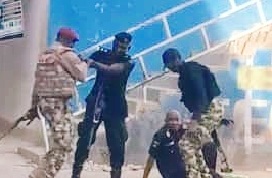
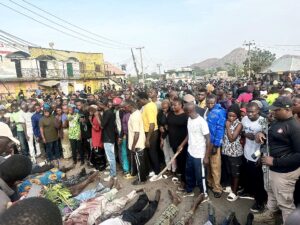
A Scene of fighting between Soldiers and Policemen
By Tony Erha
Legit, the ever-present online news outlet, had screamed “Soldiers Beat Policeman in Jos, Seize His Rifle as Onlookers Panic”. This is one of the frequent bodily clashes between security operatives of the different security units and public members, particularly soldiers versus policemen.
As ugly as it is, the clashes call for determined public attention, for it is a lawlessness that has become a national affliction on Africa’s most populous nation. But, why take serious a ‘mere’ show of public shame exhibited by a ‘husband and wife’ (soldier and a policeman), whereas the country is daily awash with arsons, maiming and large scale of killings of human lives?
The social disorder and human carnages have crept into Nigeria’s culture, to which forbearing Nigerians already have developed a-shockability. In-and-out, what would be regarded as abnormal is when incendiary social disorder and killings no longer take place and are occasionally reported by the mass media. It’s only for the optics; not societal correctional; that such bad news always gain prominence.
The 1967 to 1970 fratricidal civil war, with unwarranted military’s intervention in state’s power and its fistic public conducts; is a huge burden on the Nigerian civility, for it has transposed mental imbalance on an army of occupation, Nigerian public institutions and individuals.
Indeed, the republics of 1966, 1979, 1993 and 1998, that had transited from military dictatorship to civilian rules, are grossly implicated as having failed to prepare the military and the populace to a democratic mental equilibrium, that have crept along as public unruliness.
Sylvester Odion Akhaine, a human rights activist and professor of political science from the Lagos State University, had always moved for ‘demilitarisation’ from the incivility of the military rule that had perpetually retarded Nigerians, and spoils our nascent democratic experience.
The Centre for Constitutionalism and Demilitarization (CENCOD), Akhaine’s NGO, even in the draconian army era, had drawn a similarity that all the country needed to break from the manacles of retarded military rule, was already in place at the Armed Forces Resettlement Centre (AFRC), Oshodi, Lagos, that makes it compulsory that retiring soldiers are provided with quality training, geared to overcome the challenges of re-integration into civil life. Even though soldiers are barely reoriented on this, the grassroots people ought to be also ‘rehabilitated’ from the civil disorientation the military governance had imposed.
A simple understanding of the dual purpose of the Prof Akhaine’s CENCOD posit, was that Nigeria do away with constitutional portions that retard the nation, like the unitary misposition that creeps into and destroys a tailor-made federal constitution that unify its diversities. CENCOD’s recipe is also the wayforward as propagated by the Lower Niger Congress (LNC) group.
Soldiers should be respected and dreaded. It wasn’t until the Nigeria civil war thatb it dawned on me what a soldier actually looked like and who he was. For the first time, I encountered men in varied khaki uniforms that made recognition of the real ‘soja’ somewhat complicated. It was like taking the earthworm or the millipede for a snake.
There were the dreaded forest guards in greenish uniform, which blended with the forest greens, that earned them ‘Ivbiekpo’, a Benin name for the dangerous, gentle snake that emerges from the grass, striking its unsuspecting victims to death. Called, ‘Olakpa Araba’, (policemen for the rubber trees), they were soldiers of the forest. And woe betided poachers caught by them, in the designated and fully protected areas of the forest-canopy of their command, called the ‘forest reserve’.
Ii is not only the firearms that soldiers carry which gives them the raw-clout and human force. But the uniform; camouflages and audacity. Some people say that they are injected in the head and trained to killed. Fela Anikulapo Kuti, the late Afro beat maestro, also sang derogatorily in his epic music, “Uniform na cloth, na tailor dey sew am”, thus imputing that uniform could be sewed by every Tom, Dick and Harry. But uniform might be sewn by all, but not the intoxicating one, authorised by the state.
In my locality, there were the tax collectors in khaki uniform who usually had preyed on tax defaulters. They prowled in ‘Tore Na Gbina’, wooden lorries also called ‘Bole Ka Aja’, meaning both in Benin and Yoruba, ‘Come down and let us fight’.
Wherever they journeyed to and disembarked, there were bound to be heated arguments and physical fights, in accord with its real name, ‘Come down and let us fight’. In the early hour of the mornings, when men were still in the warmth of their wives and catnaps, the diehard tax collectors had manifested, causing pandemonium to my innocent villagers.
They usually left behind their ‘Tore Na Gbina’, stealing into the village, when the serial dodgers of ‘head-tax’, hardly noticed their presence. They would bundled their victims away, but not without engaging in fisticuffs.
It was the senseless and fratricidal war, also called the Biafra war, which brought most children and youth of that era, to the awareness of the soldiers. They were sighted in a blue moon, whilst their mention caused trepidation. Families that have soldiers as children were feared. ‘Soja’, indeed, was a ghost; a scarecrow to frighten and correct unruly children, by unsettled parents.
One unsacred morning, even as it rained cat and dog, there emerged from the surrounding thickets of my village, the ‘Federal troops’, who were on the heels of some young and handsome ‘Biafrans’ that groped through my village, a night before. The youngsters, who claimed to have been trapped between the pogroms, were later reduced to skeletons beyond the village, where the hardhearted went for sighting. No society takes soldiers for granted.
Some pressure groups are pushing for the Nigeria’s National Youth Service Corps (NYSC) members, trained with parents’ hard-earned money, to be conscripted as soldiers, in their one year compulsory service! Why must the youths that are props in their parents’ old age be mystified like Israel, where all and sundry carry a gun?
A people deserves the kind of soldiers they have, we are always told. From the Biafra war until about three decades ago, the Nigerian soldiers, known for discipline and war-readiness, had turned a tamed lion invited to a fight by a hegoat. An apology to the late Lt. General Salihu Ibrahim, of “an army of anything goes”. No, it isn’t the fierce amber fire that should birth the cold ashes.
In early 1970s, the Yakubu Gowon militry government had deployed soldiers to impact discipline in Nigerian secondary schools, in the like manner the Mohammadu Buhari and Tunde Idiagbon junta brought about War Against Indiscipline (WAI). An army couple Okpodu, seconded to my school was always a drunk that turned my school compound into a ‘Mami Market’, where illicit ‘Paraga’, ‘Ogogoro’ or ‘Sapele Water’ (dry gin) were consumed. But how could a man, who the students see drinking to a stupor, instil discipline in disobedient students?
The undue deployment of soldiers to civilian beats, without the needed ‘rehabilitation’ in order to master the civilian populace, is not only inherent risks to the civilian populace, as it also brings public’s contempt to the once dreaded ‘merchant of death’ and its parent institutions. Such undue postings to the civilian spaces, have brought them to corruptive influences, where soldiers have become private guards to civilians, rent collectors and settlers of scores.
It is irksome that military authorities enter into unholy matrimony between soldiers and policemen. The norm had been that soldiers and policemen are joined to mount roadblocks, where police extort lesser tolls as bribe from road users and the army huger collections. Mixing the once incorruptible soldiers with most policemen, that are ineptly personified, could be partly responsible for the compromise alleged to be impeding the victory on the decade-long insecurity that has besieged the nation.
However, all hope is not being lost as the country’s Chief of Defence Staff and others are apparently turning the tide on intense terrorist and bandit attacks against the nation, where the civilian populace wouldn’t have to take it upon themselves to become soldiers to overcome. With sheer determination, the military authority had announced the dismantling of roadblocks mounted by soldiers, nationwide.