Iran’s Pezeshkian Urges Unity as Protests Over Economic Woes Turn Deadly
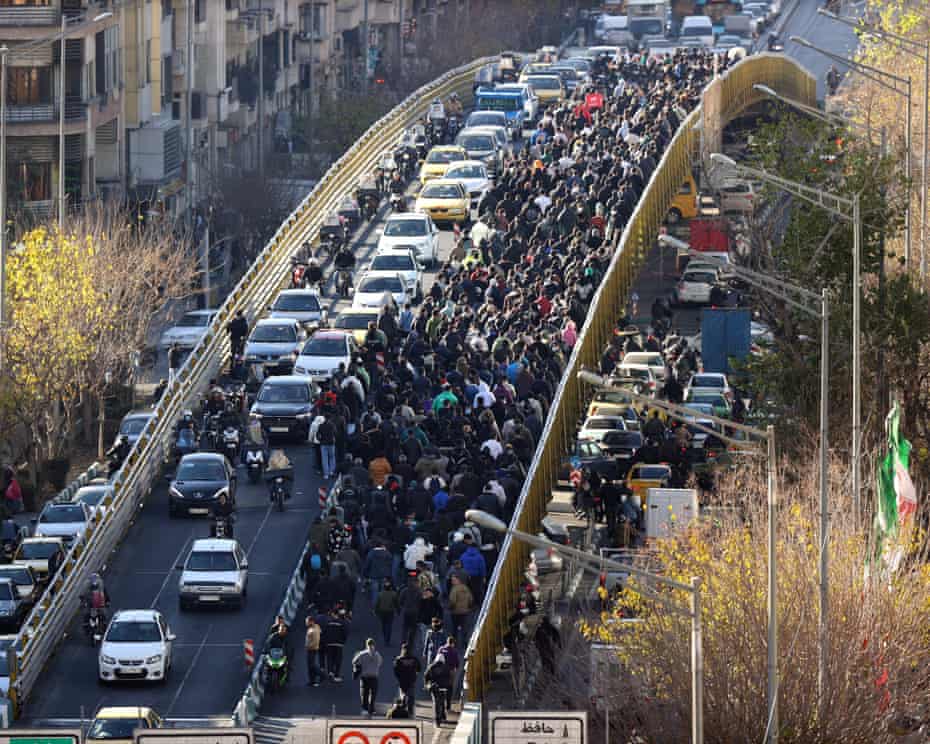
State media says one security officer killed and 13 wounded in western Lorestan as protests continue and spread for a fourth day in Iran.
Meanwhile, Iran’s President Masoud Pezeshkian has appealed for unity in the face of economic pressure from Tehran’s “enemies”, as protests over soaring living costs spread across the country. Pezeshkian’s appeal on Wednesday came as security forces in the southern Fars province also opened fire on protesters who tried to break into a local government building there.
The unrest marked the fourth consecutive day of protests in Iran since shopkeepers in Tehran took to the streets on Sunday as the rial plunged to record lows against the United States dollar, exacerbating economic hardship amid high inflation and rising living costs.
Speaking at a business forum in Tehran, Pezeshkian suggested foreign interference was to blame for the unrest.
“We are in a situation where external pressures are being exerted by the country’s enemies and, unfortunately, within the country as well,” he said.
The Iranian president went on to call for unity, saying the country was engaged in a “full-scale war”.
“Right now, the enemy has placed most of its hopes on knocking us down through economic pressure. You cannot conquer a nation with bombs, fighter jets, or missiles,” he said.
“And if they were to confront this nation on the ground, if we remain determined, united, and committed to working together to make our country proud, it would be impossible for them to bring Iran to its knees,” he added.
European powers in September of this year initiated the return of United Nations sanctions, too, accusing Iran of violating the 2015 deal. The move came months after Israel and the US bombed Iranian nuclear sites.
The country’s rial currency has lost nearly half its value against the dollar in 2025, with inflation standing at about 50 percent in December. The currency was trading at about 1.42 million rials to the US dollar when the protest by the shopkeepers in Tehran’s Grand Bazaar began on Sunday, compared with 820,000 rials a year ago.
The protests have since drawn in students at Tehran’s universities and spread to several other cities, including the cities of Isfahan, Yazd, Zanjan, Kuhdasht and Fasa, according to state media.
In Kuhdasht, located in western Lorestan, state media said that an officer with the paramilitary Basij force had died in “violent action” by “rioters”. The IRIB broadcaster identified the officer as 21-year-old Amir Hossam Khodayari Fard.
The broadcaster cited a security official as saying that the unrest that killed the young officer and wounded 13 of his comrades was orchestrated by “opportunistic elements affiliated with the enemy” who he said took advantage of the “atmosphere of popular protests” in the country.
It did not say if there were casualties among the protesters.
In Fasa, located in southern Fars, an official said protesters attacked the provincial governor’s office, destroying a portion of its door, according to the semi-official Mizan agency.
Three members of the security forces were wounded during the incident, while four “attackers” were detained, reported the semi-official Tasnim agency.
A video carried by state media showed a group of people trying to break open the gate of the building.
The governor of Fasa told state media that “the protests were caused by inflation and economic conditions. Individuals influenced by hostile channels and media participated in them … the situation is back to normal.”
‘Decisive response’
Iranian authorities have responded to previous protests over issues ranging from prices, drought, women’s rights and political freedoms with forceful security measures and extensive arrests.
This time, the government said it would set up a “dialogue mechanism” with leaders of the demonstrations, though it has not said how the process would work.
“The government will listen patiently even if there are harsh voices because we believe our people are patient enough, and when their voices are raised, the pressure that is being put on them is high,” Fatemeh Mohajerani said at a news conference in Tehran.
“The government’s job is to hear the voices and help them reach a common understanding to solve the problems that exist in society.”
She said the government recognised the right to peaceful assembly. “We see, hear, and recognise officially all the protests, the difficulties, and the crises.”
The country’s top prosecutor, Mohammad Movahedi-Azad, meanwhile, warned of a “decisive” response if protesters destabilise the country.
“Peaceful livelihood protests are part of social and understandable realities,” Movahedi-Azad said.
“Any attempt to turn economic protests into a tool of insecurity, destruction of public property, or implementation of externally designed scenarios will inevitably be met with a legal, proportionate and decisive response.”
Fears of escalation
Al Jazeera’s Tohid Asadi, reporting from Tehran, said the government is sending mixed messages over the protesters’ concerns.
On the one hand, he said, Pezeshkian has expressed his sympathy for the economic hardships faced by many, while the government had already taken action in replacing the head of the central bank on Monday.
On the other hand, he said, there are serious concerns for the state about the possibility of “escalation” by the protesters.
He said while economic challenges are the biggest concern for most Iranians, the shadow of a renewed conflict with Israel and the US loomed large for many, adding “a huge burden upon the shoulders of ordinary citizens”.
But their “number one priority”, he said, is the improvement of the economic situation, “particularly with respect to the increasing prices that they see”.
Some analysts say the Iranian public did not have faith in the government’s ability to address the economic problems.
“The president himself came out about a week or so ago and said that he can’t do anything about these problems,” said Trita Parsi, executive vice president of the Quincy Institute for Responsible Statecraft.
“Much of the lack of faith in the government’s ability to address these problems is actually because of statements by the government itself,” he said.
Parsi said the big question now was whether the protests would gather momentum and evolve into a broader channelling of public anger over issues other than the country’s economic problems.
“Protests at times can start based on economic grievances, which is the case here, but quickly morph into other demands,” he said.
Multiple challenges
Iran’s economic problems are severe, but they are far from the only challenges. The country is also dealing with an energy crisis, while most dams feeding Tehran and many other big cities remain at near-empty levels amid a severe water crisis.
Iranian state media reporting on the protests has emphasised that they are motivated by the unchecked depreciation of the rial, rather than wider disenchantment with the theocratic establishment that has been ruling the country since the 1979 revolution.