
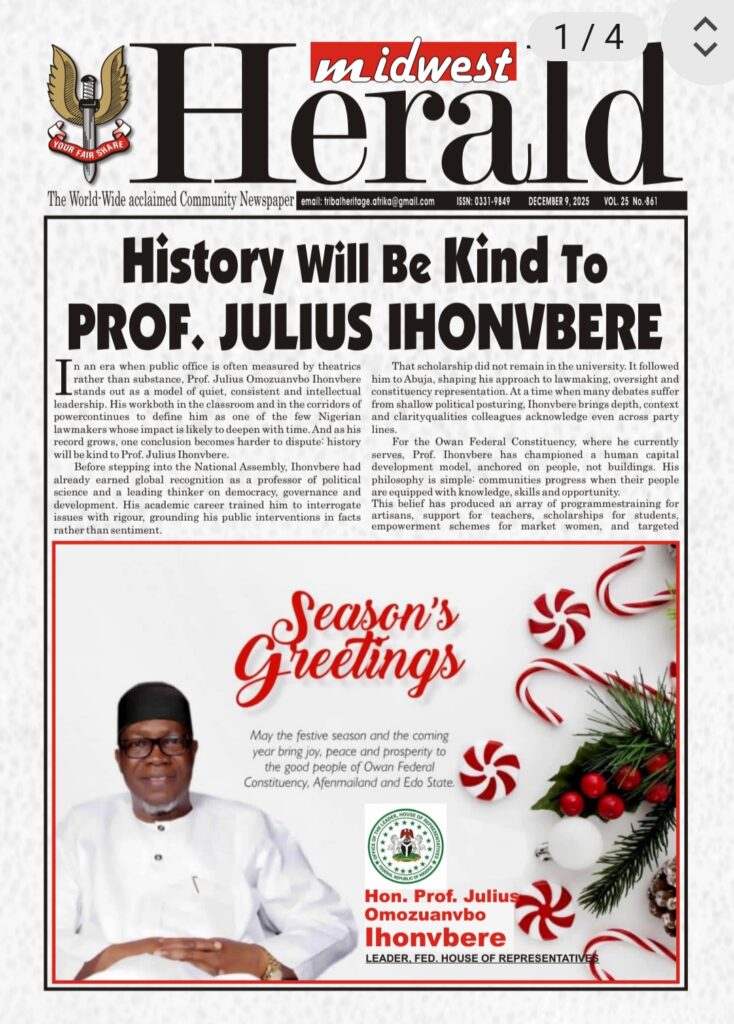
History Will Be Kind To Prof. Julius Ihonvbere

Hon. Prof. Julius Ihonvbere
By Momodu Akhoria
In an era when public office is often measured by theatrics rather than substance, Prof. Julius Omozuanvbo Ihonvbere stands out as a model of quiet, consistent and intellectual leadership. His work—both in the classroom and in the corridors of power—continues to define him as one of the few Nigerian lawmakers whose impact is likely to deepen with time. And as his record grows, one conclusion becomes harder to dispute: history will be kind to Prof. Julius Ihonvbere.
Before stepping into the National Assembly, Ihonvbere had already earned global recognition as a professor of political science and a leading thinker on democracy, governance and development. His academic career trained him to interrogate issues with rigour, grounding his public interventions in facts rather than sentiment.
That scholarship did not remain in the university. It followed him to Abuja, shaping his approach to lawmaking, oversight and constituency representation. At a time when many debates suffer from shallow political posturing, Ihonvbere brings depth, context and clarity—qualities colleagues acknowledge even across party lines.
For the Owan Federal Constituency, where he currently serves, Prof. Ihonvbere has championed a human capital development model, anchored on people, not buildings. His philosophy is simple: communities progress when their people are equipped with knowledge, skills and opportunity.

This belief has produced an array of programmes—training for artisans, support for teachers, scholarships for students, empowerment schemes for market women, and targeted interventions for youth employment. These investments rarely trend online, but they shape lives in the way governance should.
One of his most cited strengths at the grassroots is accessibility. Constituents speak of a representative who listens, follows up, and maintains visibility long after elections. Whether it’s rural electrification challenges, education support, or small-scale community projects, Ihonvbere demonstrates the discipline of consultation and the humility to engage.

In an environment where representation is often distant, he maintains a working relationship with communities, traditional institutions, civil society groups and the local government structures. This has helped him address developmental concerns with precision rather than guesswork.
Within the House of Representatives, he is regarded as a steady voice of reason—calm, articulate and informed. His positions on constitutional reform, education, security and governance carry the weight of scholarship and field experience.
Legislative aides familiar with House proceedings often reference his ability to link national policy with local realities. His interventions reflect a nuanced understanding of how federal decisions ripple through rural communities like those in Owan.

Nigeria’s political climate is notoriously unforgiving, and reputations rarely survive the cycles of propaganda and power struggle. Yet some legacies endure because they are built not on noise but on tangible service.
Prof. Ihonvbere’s work may not always attract the fireworks of political drama, but it is steady—anchored on integrity, intellectual grounding and a genuine commitment to development. These qualities form the type of leadership historians celebrate long after the dust of politics settles.
History rewards those who used their platforms to advance knowledge, uplift communities and strengthen institutions. On each of these counts, Prof. Julius Ihonvbere has established a record that is difficult to ignore.
He is a scholar who brought ideas into politics, a representative who elevated human capital above vanity projects, and a public servant whose work continues to empower thousands across Owan and beyond.
In a country searching for credible models of leadership, Ihonvbere’s story offers an important reminder: service, when grounded in principle, outlives political cycles.
And for this reason, when the future finally assesses today’s leaders, history will be kind to Prof. Julius Ihonvbere—because he has been kind, fair and consistent with his people.