
Abia’s Quiet Revolution: How Dr. Alex Otti is Rewiring a State Long Trapped in Decay
By Comrade Orobosa Omo-Ojo JP
Abia State had for decades, sat at the edge of national conversations — often for the wrong reasons. Once a proud commercial hub driven by the ingenuity of Aba’s craftsmen and traders, the state steadily slid into a reputation defined by collapsing infrastructure, dysfunctional public services, unreliable electricity, and governance marked by inertia.
The phrase “Aba is finished” became common shorthand among traders lamenting the mess of potholes, floods, noise from generators, insecurity and broken public trust.
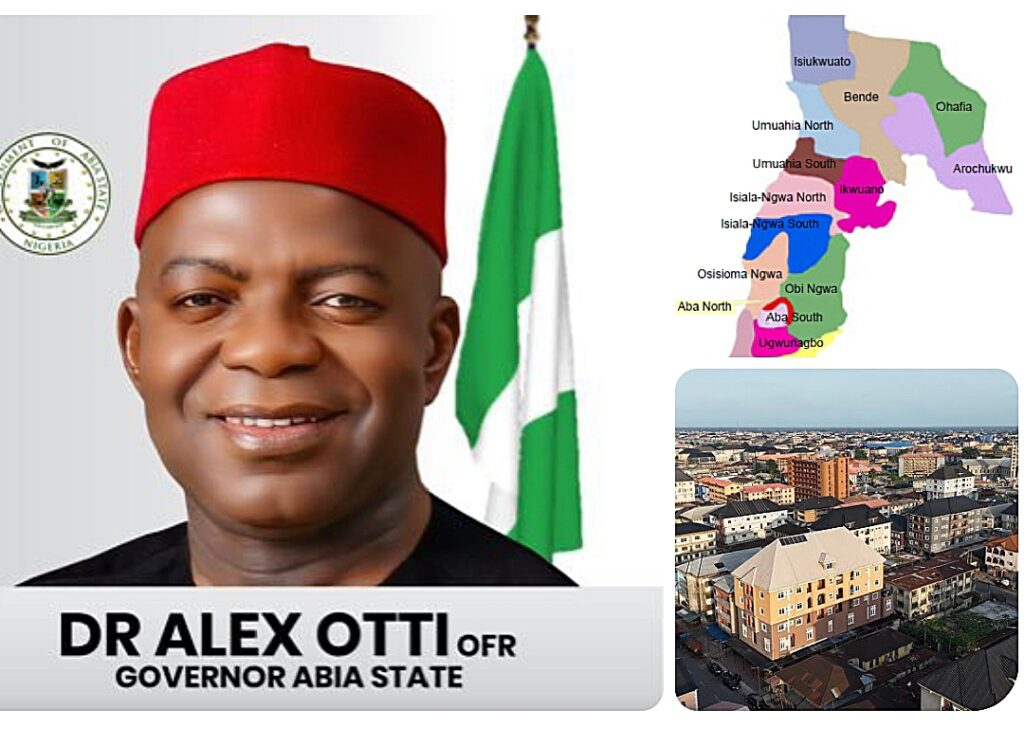
But, in May 2023, the political landscape shifted. Dr. Alex Otti, economist, reformist banker and two-time gubernatorial contender, finally broke through the wall of entrenched political structures to emerge governor.
Expectations were high — almost dangerously so. Sceptics doubted Otti’s strength to deliver. But for many who had followed his impactful performances in the private sector, the question was not whether Otti had ideas; it was whether Abia’s longstanding rot could be reversed at all.
In just two years plus, the picture emerging across the state is strikingly different from the pre-2023 landscape. Whether in road infrastructure, healthcare delivery, fiscal management, power supply, public-sector morale, or education, Abia today presents a “Before versus After” story that is difficult to ignore.
While the deeper structural transformations will take more years to fully mature, early indicators show a state in the middle of a deliberate rebuilding effort — one that is beginning to reshape how residents experience governance.
This special report will examine ten flagship areas where significant, measurable change is unfolding under Dr. Otti. It will show what Abia looked like before; what has changed, and why these shifts matter.
- Aba’s Roads: From National Embarrassment to Construction Hub.
Before 2023, many major roads in Aba were symbols of state failure. Port-Harcourt Road — once the industrial artery of the city — had disintegrated so badly that large trucks regularly got stuck in craters that passed for roads. Floodwater consumed entire streets during rains, forcing traders to wade through filthy pools just to get to their shops. Entire sections of Aba’s commercial core were effectively cut off during the rainy season.
Today, those narratives are changing:
In June 2025, in an unprecedented urban-renewal push, Governor Otti commissioned 14 roads in Aba in a single day. Port-Harcourt Road, long abandoned, has undergone full reconstruction as a modern three-lane carriageway with proper drainage. Streets that once hosted stagnant water and heaps of refuse now carry solar streetlights, new drainage systems, and smooth asphalt surfaces.
For traders in Ariaria, Bakassi, Asa, and Ngwa Road, the transformation is not abstract. Transport time has shrunk, shop access has improved, and logistics costs have fallen. A major commercial city long defined by neglect is now emerging as a construction zone reborn.
- Primary Healthcare: From Dysfunction to Rapid Rehabilitation:
No sector demonstrated the collapse of public infrastructure in Abia more clearly than the primary healthcare system. For years, countless Primary Healthcare Centres (PHCs) existed only on paper. Many had no drugs, no beds, no functional water supply, and in some cases, no staff present. Rural families were forced to travel long distances or rely on patent medicine shops for basic medical care.
In January 2025, Otti launched Project Ekwueme, an ambitious plan to renovate, equip, and functionalise 200 PHCs within 100 days. While the timeline proved ambitious, progress was undeniable. By mid-to-late 2025, roughly 140 PHCs had undergone rehabilitation, new equipment installations, and staffing improvements. Several now have oxygen supply, basic laboratories, solar power, and functional delivery rooms.
The effect is profound. In rural communities from Umunneochi to Ukwa, mothers no longer have to travel hours for antenatal care. The state’s health-insurance enrollment has surged. Instead of building new hospitals that sit empty, the administration has opted to strengthen the grassroots foundation of healthcare — a move health experts widely commend.
- Power Supply: Aba IPP Turns the Tide:
Aba’s famed entrepreneurial energy was long undercut by a chronic enemy: electricity. For years, the city — home to thousands of artisans, shoemakers, welders, tailors, and small manufacturers — struggled under unreliable grid power. Generators roared from dawn to dust, consuming capital and choking productivity.
The Aba Integrated Power Project (IPP), though conceived long before Otti’s tenure, finally came alive in 2024 under an atmosphere of renewed government partnership and regulatory clarity. The 141MW facility, with its dedicated gas pipeline and ring-fenced distribution network, became operational — a historic milestone for the Southeast.
The Otti administration promptly aligned state planning with the new power ecosystem, supporting metering rollout and industrial-cluster integration.
The result? Businesses that previously spent thousands weekly on diesel now report more regular power supply. Production lines that once operated intermittently can now plan their work schedules with greater certainty. The arrival of the IPP has not solved all power issues, but it has fundamentally changed the calculus for industrial operations in Aba.
- Education: From Overcrowded Classrooms to Infrastructure & Teacher Expansion.
Before Otti assumed office, many schools in Abia were a heartbreaking sight: leaking roofs, broken desks, overcrowded classrooms, and insufficient teachers. In some communities, a single teacher handled multiple classes.
In response, the administration launched one of the most aggressive education interventions in the state’s history:
Construction of nearly 500 new classrooms
Rehabilitation of over 200 aging classrooms
Recruitment of 5,394 teachers (with more planned)
The recruitment exercise in September 2025 alone was the largest single injection of teaching manpower in modern Abia history. By combining infrastructure with manpower, the government positioned the education sector for long-term revitalisation.
Combined with the “Free and Compulsory Basic Education” policy, the revitalised public-school system is gradually restoring parents’ confidence in sending their children to government schools.
- Budgeting for Development: From Consumption to Construction:
One of the most defining shifts under Otti is fiscal reorientation. For years, Abia’s budgets were criticized for allocating too little to capital expenditure, leaving critical infrastructure starved of investment.
The 2024 and 2025 budgets reversed that trend dramatically. The 2025 budget of ₦750.28 billion allocated about 82% to capital projects — one of the highest capital-to-recurrent ratios in Nigeria.
This strategic shift enabled:
Major road projects
PHC rehabilitation
School construction
Water and sanitation projects
Agro-industrial planning
Specialist hospital upgrades
The message was unmistakable— government spending must translate into visible development, not bloated administrative overheads.
- Federal Roads: From Endless Delay to State Takeover:
Another contrast between “before” and “after” lies in federal road projects that had lingered for years without meaningful progress. Abia residents suffered the consequences — terrible federal highways, contractor abandonment, and traffic nightmares during rainy seasons.
In 2025, the Federal Government formally transferred some federal roads to the state government for completion. Instead of political grandstanding, Otti accepted the responsibility and mobilised contractors immediately. Roads long tied up in bureaucratic delays saw fresh momentum.
The accelerated completion of these routes is already improving interstate mobility and supporting the logistics chain that feeds Aba’s commercial ecosystem.
- Secondary & Tertiary Healthcare:
Specialist Upgrades and ABSUTH Revitalisation
While PHCs provide the foundation, Abia’s secondary and tertiary hospitals had their own crisis. The Abia State University Teaching Hospital (ABSUTH) struggled with accreditation issues, deteriorating facilities, and staff shortages. Patients regularly bypassed state hospitals for private clinics.
Under Otti, the administration began a phased rehabilitation of major hospitals, including upgrading some to specialist hospital status, equipping others with modern diagnostics, and improving the learning environment for medical students and house officers.
ABSUTH benefited from new hostels, improved lecture theatres, and re-engagement with medical regulatory bodies. For the first time in years, the teaching hospital began regaining lost ground in accreditation and service delivery.
- Pensions & Salaries: From Painful Backlogs to Predictability
Perhaps nowhere was the previous administration’s failure more visible than in the accumulated arrears owed to retirees and civil servants. Some pensioners had gone years without payments. Protests became routine.
Otti inherited pension liabilities running into tens of billions. Instead of spreading the burden across years, the state chose an aggressive clearance program:
Backlogs affecting over 12,000 retirees were settled.
Monthly pension payments became regular.
Salary payment dates were stabilised, helping workers plan their lives again.
Beyond the numbers, the psychological impact is substantial. Civil servants, once demoralised, now speak of restored dignity. Public trust — battered by years of broken promises — is slowly returning.
- Urban Clean-Up: The Return of Order, Lights & Drainage:
Aba’s drainage and waste-management situation used to be an embarrassment. During rains, entire neighbourhoods were overwhelmed by runoff from blocked drains. Waste heaps dotted major roads. Night-time travel was risky because of pitch-dark streets.
Today, the urban renewal drive includes
Large-scale drain desilting
Modernized solid-waste management
Deployment of solar-powered streetlights on major corridors
Regrading of flood-prone streets
Beautification of public spaces
The effect is instantly visible. Night-time commerce has increased. Flood duration after heavy rainfall has reduced. Cleanliness is improving, and the aesthetics of the city now send a visual signal that government is present and paying attention.
- Agro-Industrial Development: From Untapped Potential to Strategic Planning
Abia has always had agricultural potential, but before 2023, there were few structured attempts to create agro-industrial value chains. Farmers operated in silos. Processing clusters were minimal. Market access wasn’t optimized.
The Otti administration’s 2025 budget changed that narrative by allocating significant funds to create agro-industrial zones in Bende, Ukwa, and Umunneochi. These zones aim to attract agro-processing investments, strengthen value chains, and foster rural employment.
The initiative is still in early stages, but it marks an intentional move to diversify Abia’s economy away from trade alone — toward a mix of agriculture, industry, and services.
The Bigger Story for Abia State and Dr. Alex Otti is that Abia is reconnecting with itself.
Beyond the technical details — kilometres of roads, megawatts of electricity, classroom numbers, or budget ratios — the transformation in Abia under Alex Otti represents something more fundamental: a government re-establishing the social contract without unnecessary noise to gain headlines or fight political opponents.
Businessmen—artisans, traders, farmers, pensioners and investors speak of a new sense of visibility — the feeling that the state is no longer absent. Traders in Aba say business is reviving not because of cash injections, but because ‘Otti don clear road.’
Teachers morale has improved not because of incentives, but because according to the NUT “we now have colleagues and classrooms that make sense.” Health workers in rural wards say they finally have equipment and 24/7 light.
However, Abia challenges remain enormous. The state needs many more kilometres of roads, stronger tertiary healthcare, expanded potable water systems, and deeper institutional reforms. A single administration cannot reverse decades of decay overnight. But what is clear is that the foundation is being reset stronger and transparently.
In a country where citizens have grown used to abandoned projects, missing contractors, and elaborate excuses, Abia’s current governance model demonstrates that development is not magic — it is management, priorities, and political will.
That is why, two years into Dr. Alex Otti’s administration, the most significant change in Abia may not be the roads or schools themselves. It is the emerging belief among residents that progress is possible — and that government can, in fact, work.