
Shaibu Inspects South-South NIS Zonal Office, Reflects On Service, Legacy and Maintenance Culture
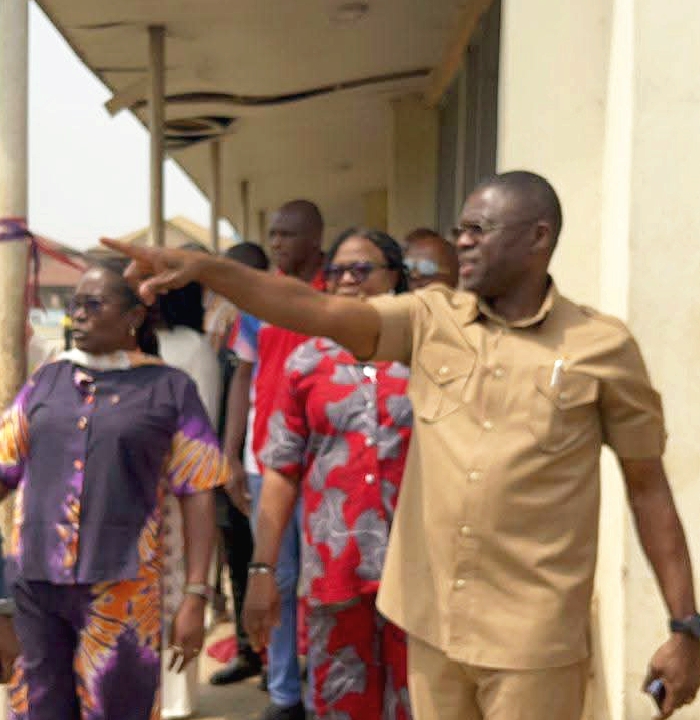
NIS Boss, Shaibu
The Director-General of the National Institute for Sports (NIS), Rt. Hon. Comrade Philip Shaibu, on Tuesday led officials of the Edo State Sports Commission and members of the press on an inspection tour of the South-South Zonal Office of the National Institute for Sports in Benin City, ahead of the resumption of staff activities.
The visit, which followed an earlier inspection carried out last year, was aimed at assessing the level of readiness of the facility and identifying areas requiring urgent attention before full operations resume.
Addressing journalists during the tour, Shaibu delivered a reflective message on leadership and public service, stressing that every opportunity to serve comes with lasting consequences.
“When you are given an opportunity to serve in any position, serve well,” he said. “You never can tell when you will leave that position. One day, you may need to enjoy the benefits of the good you did or face the consequences of what you failed to do.”
Shaibu took time to recall his first encounter with the facility in 2018, when he visited the centre as Deputy Governor of Edo State during preparations for the 2020 National Sports Festival.
According to him, the facility was then in a deplorable state, so bad that some advised the government to abandon it entirely. “The place was a mess,” he recalled.
“People said we should forget about it, but I refused. I took it upon myself to revive the facility and reclaim the property for the Edo State Government.” That decision, he noted, has now come full circle.
“If I had listened to opinions and failed to fix this place at that time, I would not be standing here today as the Director-General of NIS. Today, I am reaping the benefit of that decision. I am happy that the facility is still standing strong and fit for use.”
The DG explained that the inspection was carried out jointly with the Edo State Sports Commission as part of a collaborative effort to strengthen sports development in the state and the South-South region.
While acknowledging the structural stability of the facility, Shaibu pointed out areas that require immediate upgrades.
“There are some amendments needed, doors, windows, toilet facilities, and we will work on them to make the environment more habitable.
We are also engaging the Edo State Government on office space, because what we currently have here is not enough to make NIS fully effective.”
Reaffirming Edo State’s reputation as a sports powerhouse, Shaibu declared that the state’s status as the heartbeat of sports in the South-South remains unshaken.
“Edo is known for sports, and that identity will not change,” he said.
However, the DG admitted that he was not entirely impressed with the current state of the facility, especially given the urgency to commence NIS basic training programmes.
“We are in a hurry to start our programmes, and I hope that before staff resumption, the facility will be ready. I have been to other states, Ogun is ready, Taraba is ready, Enugu is ready, all thanks to their state governments and sports commissions.”
Shaibu also revealed plans to bring the College of Physical and Health Education, Afuze, into active use through collaboration with the Edo State Government.
“We are in a hurry to do this because we must train our athletes across all 42 sports at the basic level. Our games masters and coaches need foundational training. You don’t build champions without strong basics.”
On sports infrastructure, the DG strongly criticized the culture of building facilities without a corresponding maintenance mindset.
“I will not support the Federal Government wasting resources on sports facilities without first preparing our sportsmen and women on maintenance culture,” he said.
“It is not enough to build beautiful facilities.”
He lamented the poor state of national sports assets across the country, noting that Nigeria currently has only one FIFA-standard stadium, the Godswill Akpabio Stadium in Uyo.
“The National Stadium in Surulere has become a playground, while the Abuja National Stadium has turned into crusade grounds for both Christians and Muslims. That is very bad.”
Shaibu assured that under his leadership, the National Institute for Sports is determined to change that narrative.
“NIS is ready to correct this attitude and rewrite the story of sports development and facility management in Nigeria,” he concluded.
By Comrade Robinson Akhenoba, Writer and Publisher, The Political Evangelist