

2027: APC Unveils Tinubu’s Second-Term Agenda, Targets 6% Growth, 78,000 Security Personnel, 200,000 Homes
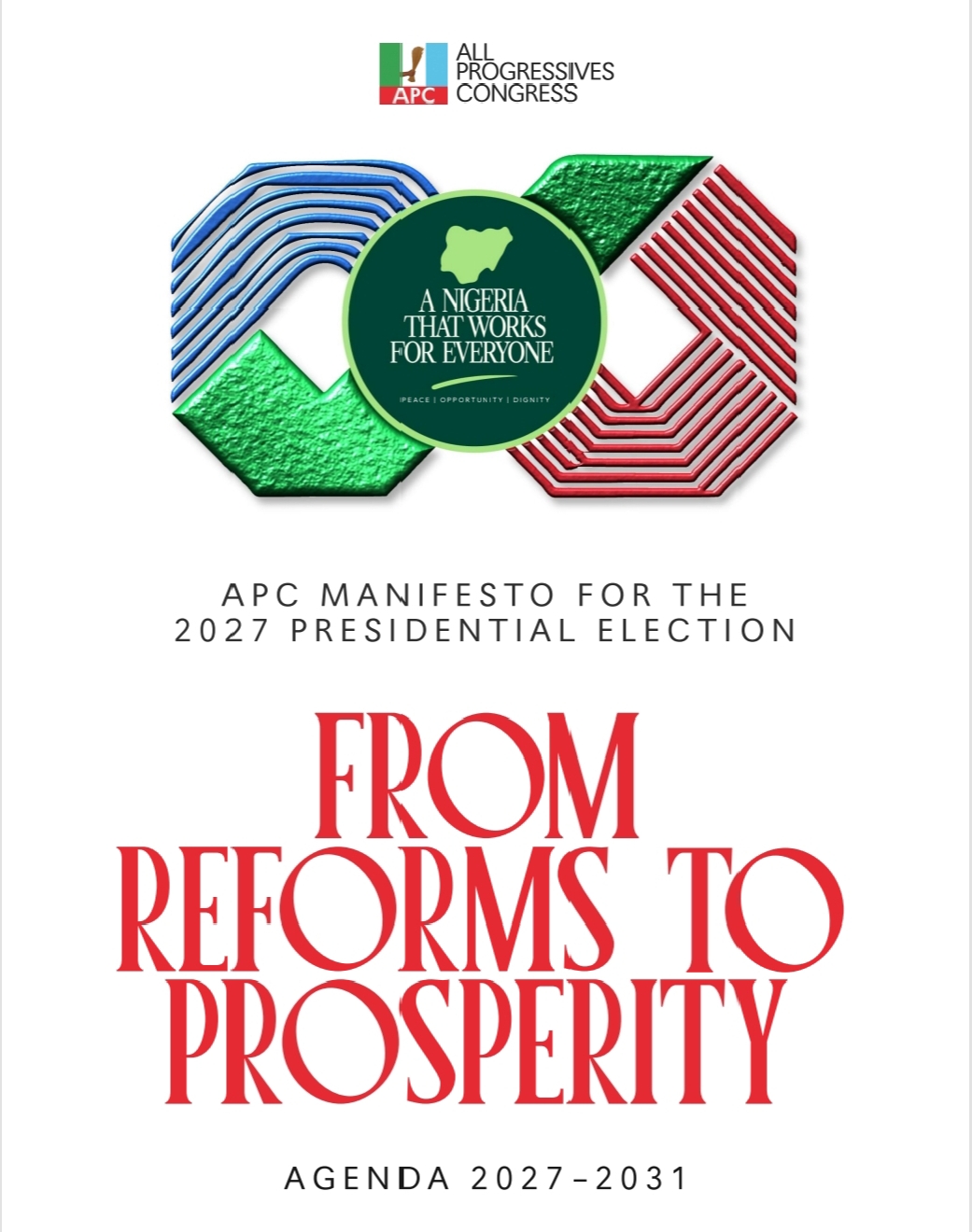
APC 2027 Manifesto
By Orobosa Omo-Ojo JP
The All Progressives Congress (APC) has unveiled its 2027–2031 presidential election manifesto, outlining President Bola Ahmed Tinubu’s second-term agenda with ambitious targets on economic growth, national security, electricity, housing, education, healthcare, agriculture and employment.
The 109-page policy document, titled From Reform to Prosperity Agenda 2027–2031, sets out the party’s proposed roadmap for transforming the economic reforms introduced during Tinubu’s first tenure into improved living conditions and shared prosperity for Nigerians.
Midwest Herald reports that the manifesto is scheduled for formal presentation on Tuesday, November 10, 2026, at the Shehu Musa Yar’Adua Centre in Abuja.
A major highlight of the document is the party’s target of achieving six per cent annual economic growth by 2031, alongside commitments to sustain a downward trend in inflation, reduce the cost of living and improve the purchasing power of Nigerians.
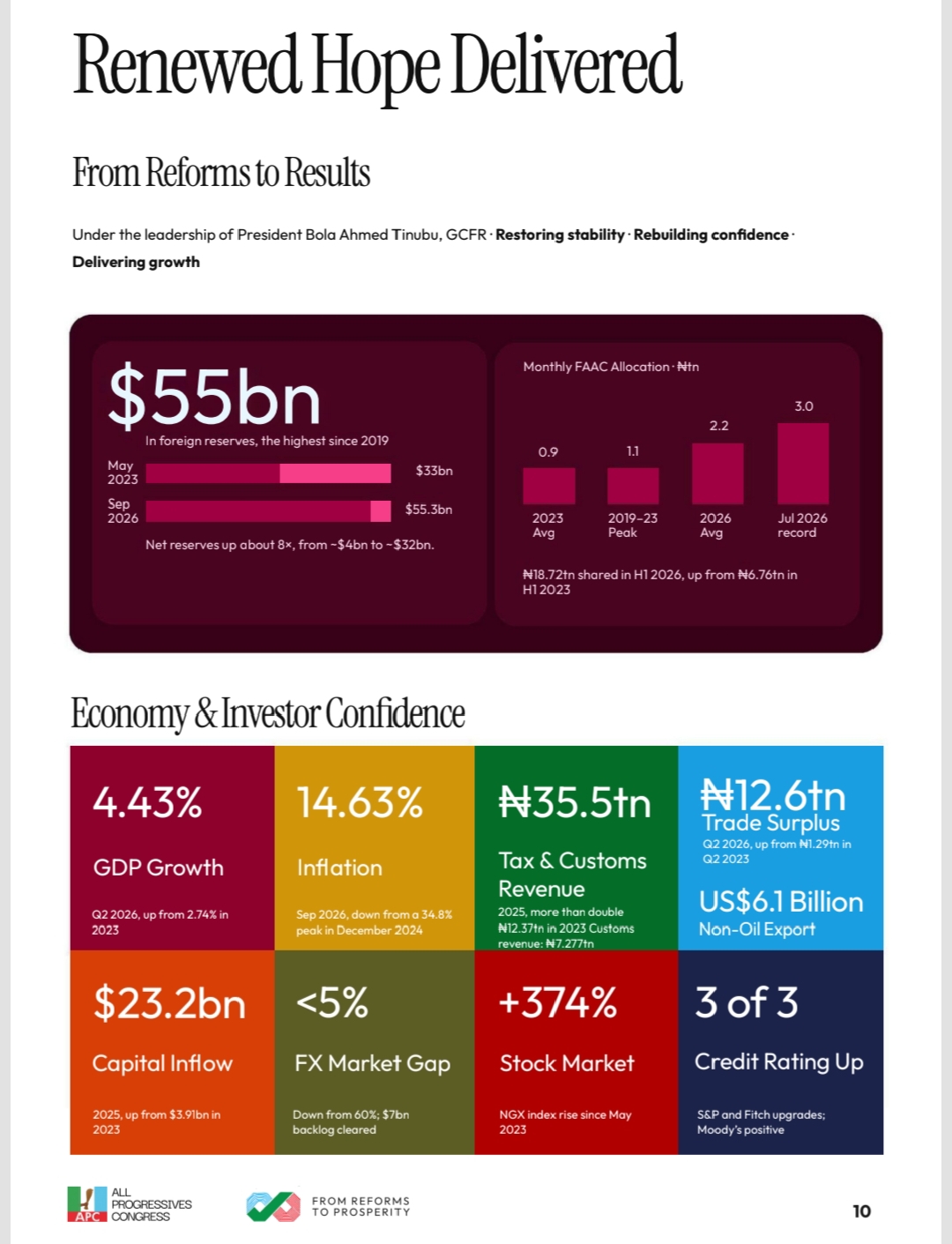
ECONOMIC GROWTH AND COST OF LIVING
The APC identifies economic growth and improved living standards as central pillars of its proposed second-term agenda.
The party promises to consolidate the ongoing economic reforms, expand business opportunities, strengthen the productive sector and ensure that the benefits of economic growth translate into improved household incomes.
The manifesto also emphasises the need to address inflation, improve purchasing power and create an economic environment capable of attracting investments and generating sustainable employment.
NATIONAL SECURITY: 78,000 ADDITIONAL PERSONNEL
On national security, the APC has proposed the recruitment of 78,000 additional security personnel, comprising 28,000 military personnel and 50,000 police officers, to strengthen the country’s response to terrorism, banditry, kidnapping and other organised crimes.
The manifesto also proposes the completion and equipping of four additional Army divisions in Makurdi, Ilorin, Jalingo and Benin City.
The proposed expansion is expected to strengthen military operations, intelligence gathering and security coverage across the country.
The party further promises to modernise security equipment, improve border surveillance and expand community-based security initiatives to protect lives, property, farmers, traders and other vulnerable groups.
ELECTRICITY: 10,000 MEGAWATTS TARGET
In the power sector, the APC has set a target of increasing available electricity generation towards 10,000 megawatts.
The party intends to improve electricity supply through investments in generation, transmission and distribution infrastructure, while expanding metering coverage to address estimated billing and improve transparency in the electricity market.
The manifesto recognises reliable electricity as a critical requirement for industrial development, small businesses, job creation and national economic growth.
HOUSING: 200,000 AFFORDABLE UNITS
The APC has also proposed the construction of 200,000 affordable housing units as part of efforts to address Nigeria’s housing deficit.
The initiative is expected to improve access to decent accommodation, stimulate the construction industry and create employment opportunities across the housing value chain.
EDUCATION: 20,000 ADDITIONAL TEACHERS
On education, Tinubu’s proposed second-term agenda includes the recruitment of 20,000 additional teachers and a commitment to halve the number of out-of-school children.
The party also promises to expand educational opportunities, improve access to quality learning and strengthen human capital development.
The manifesto recognises education as a major instrument for reducing poverty, addressing unemployment and preparing young Nigerians for emerging economic opportunities.
YOUTH EMPLOYMENT AND ACCESS TO FINANCING
The APC has set a target of halving youth unemployment by 2031.
The proposed strategy includes expanding entrepreneurship opportunities, strengthening vocational and technical training, improving access to affordable credit and supporting small and medium-scale enterprises.
The manifesto also seeks to ensure that at least half of economically active Nigerians have access to equitable financing opportunities.
The party believes that expanding access to credit will encourage business development, increase productivity and strengthen the capacity of Nigerians to participate in economic activities.
HEALTHCARE: 90 PER CENT FUNCTIONAL PRIMARY HEALTHCARE CENTRES
In healthcare, the APC is targeting an increase in functional primary healthcare centres to 90 per cent nationwide and an expansion of active health insurance coverage to 40 per cent of the Nigerian population.
The proposed reforms are expected to improve access to essential medical services, particularly in rural communities and underserved areas.
The party also identifies improved healthcare delivery as a critical component of human development and national productivity.
AGRICULTURE AND FOOD SECURITY
Agriculture and food security also occupy important positions in the manifesto.
The APC promises to increase agricultural productivity, strengthen farmers’ access to financing and markets, improve food availability and support measures to make agricultural production more competitive.
The proposed interventions are expected to contribute to food security, reduce dependence on imports and improve the contribution of agriculture to national economic growth.
INFRASTRUCTURE, INDUSTRIALISATION AND NON-OIL EXPORTS
The manifesto further identifies infrastructure development, industrialisation and non-oil exports as important drivers of economic diversification.
The party plans to strengthen road, rail and other transport infrastructure, improve connectivity between economic centres and support local manufacturing.
It also promises to expand non-oil exports as part of efforts to diversify government revenue, improve foreign exchange earnings and reduce the country’s dependence on crude oil.
GOVERNANCE AND ACCOUNTABILITY
Beyond economic and social-sector targets, the APC has identified public-sector efficiency, transparency and accountability as important requirements for achieving the proposed prosperity agenda.
The manifesto stresses the need for effective policy implementation, institutional reforms and improved public-sector performance.
However, the ambitious targets raise important questions about implementation, financing and accountability.
Nigerians will want to know the financial implications of the proposed programmes, the sources of funding, the institutions responsible for implementation and the timelines for achieving the various commitments.
The establishment of measurable annual milestones and transparent performance reporting will also be critical to determining whether the manifesto can be translated into tangible results.
FIVE ISSUES THAT COULD SHAPE THE 2027 ELECTION
The manifesto’s proposals are expected to generate considerable debate as the 2027 presidential election approaches.
Among the issues likely to dominate public discourse are the cost of living, national security, electricity supply, youth unemployment, and access to quality healthcare and education.
For millions of Nigerians, the most important test of the proposed second-term agenda will be whether economic reforms translate into lower living costs, better employment opportunities, improved security and a higher standard of living.
The APC’s 2027 presidential manifesto therefore represents an attempt to move the political conversation from the defence of ongoing economic reforms to a promise of measurable prosperity.
With the 2027 presidential election approaching, the party will be seeking a renewed mandate on the strength of its reform programme and its promise to deliver a more prosperous Nigeria.
Ultimately, the political strength of the manifesto will depend not merely on the scale of its promises but on the APC’s ability to convince Nigerians that the targets are realistic, adequately funded and achievable within the proposed 2027–2031 period.