
America Turns Blue: Trump’s Republicans Suffer Historic Midterm Rout as Democrats Capture Congress
By Correspondent
CNN projects Democratic takeover of Senate and House as voters deliver major rebuke to Trump; seven Senate seats flipped, with Texas recording a historic political upset
America’s political landscape has witnessed a dramatic shift following the November 3, 2026 midterm elections, with Democrats reclaiming control of both chambers of Congress in a major setback for President Donald Trump and the Republican Party.
The results represent a remarkable reversal of the political fortunes that followed Trump’s return to the White House in 2024, as voters across the country rejected Republican candidates in traditionally conservative strongholds.
CNN’s latest election projections indicate that Democrats have secured control of the Senate and House of Representatives, ending Republican dominance of the two chambers and setting the stage for a fundamental change in the political balance of power in Washington.
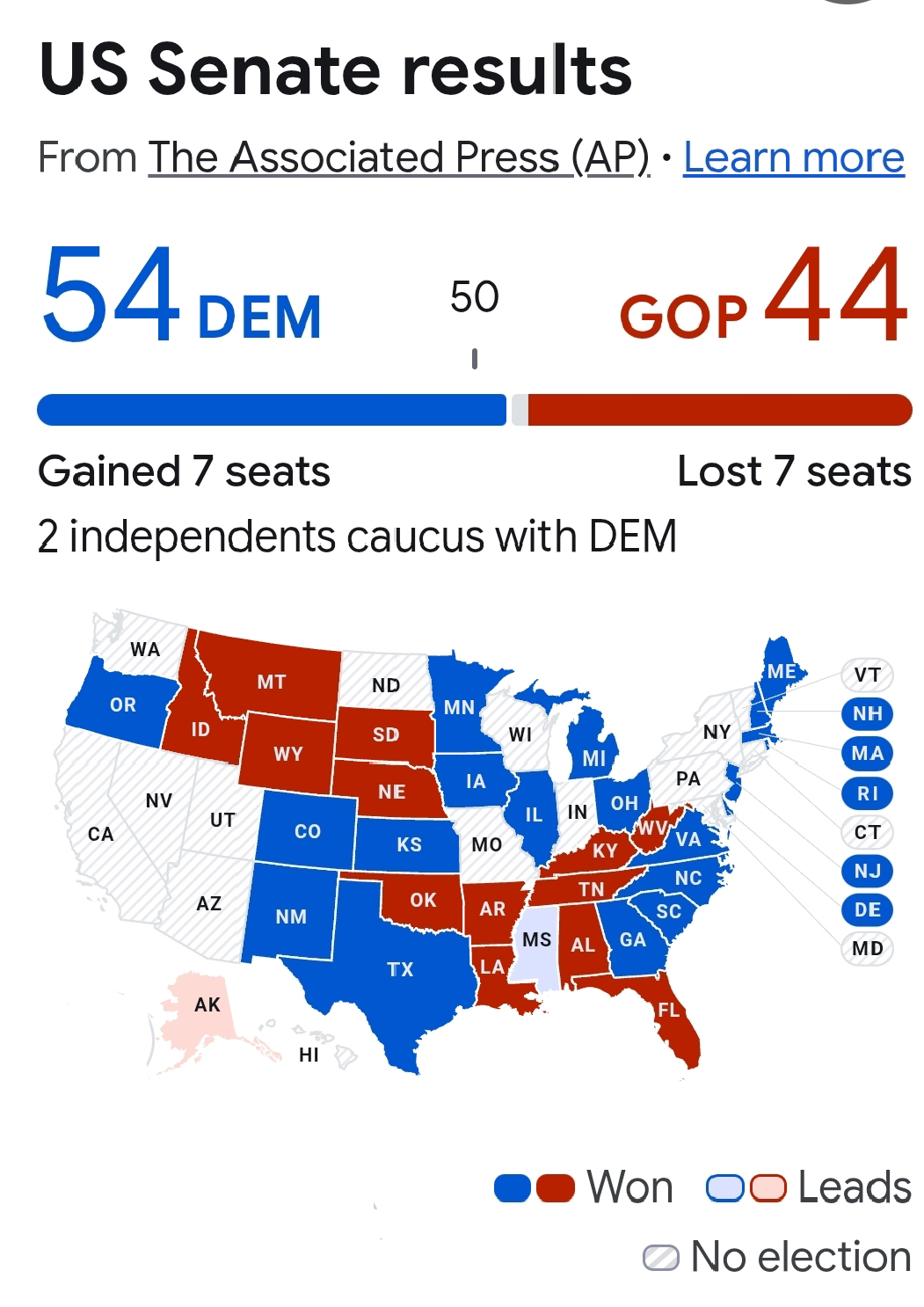
According to CNN’s November 4 results update, Democrats had secured 54 Senate seats against 42 for Republicans, with seven Republican-held seats flipped. In the House, the Democratic tally stood at 211 against 124 for Republicans in the reported results as counting continued.
The figures represent an extraordinary electoral reversal for a Republican Party that entered the elections controlling both chambers of Congress.
The Senate victories include Texas, Ohio, Kansas, North Carolina, South Carolina and other Republican-held seats, with the Democratic gains extending beyond the traditional battleground states.
Perhaps the most symbolic breakthrough came from Texas, where Democrat James Talarico defeated Republican Ken Paxton in one of the most closely watched contests of the election.
CNN’s Decision Desk projected Talarico as the winner, making him the first Democrat elected to represent Texas in the US Senate in 38 years and the first Democrat to win a statewide election in the state since 1994.
His victory is particularly significant because Texas has remained one of the strongest Republican states in presidential elections. Trump carried it by nearly 14 percentage points in 2024.
Talarico’s triumph also dealt a major blow to Trump’s political influence, given that the President had backed Paxton, the Republican state attorney-general, in the contest.
In Ohio, Democrat Sherrod Brown completed a political comeback by defeating Republican Senator Jon Husted, while Kansas voters elected Democrat Adam Hamilton over incumbent Republican Roger Marshall.
North Carolina also changed political hands, with former Democratic Governor Roy Cooper defeating Republican Michael Whatley.
South Carolina produced another major upset as Democrat Annie Andrews defeated Republican Darline Graham, a Trump-backed candidate.
The victories underscored the extent of Democratic gains in states where Republican dominance had previously appeared difficult to challenge.
CNN also reported significant Democratic gains in the House of Representatives, including victories in Florida congressional districts that Republicans had redrawn in an attempt to strengthen their electoral advantage.
Among the Democratic candidates who benefited were Kathy Castor, Jared Moskowitz and Pia Dandiya, who retained or captured seats in districts that had been reshaped to favour Republicans.
The results also pointed to a significant shift among Latino voters, particularly in parts of Florida where Republican gains recorded during the 2024 presidential election appeared to have weakened.
CNN’s election analysis described the emerging Democratic wave as a broad rejection of Trump’s leadership, noting that the President’s interventions in Republican primaries, candidate endorsements and redistricting strategy had failed to protect his party’s congressional majorities.
The election outcome has raised fresh questions about the political direction of Trump’s second administration and the extent to which his policies have alienated voters beyond the traditional Democratic base.
Economic concerns, immigration enforcement, rising living costs, tariffs and the administration’s handling of the war with Iran featured prominently in the political debate.
In several traditionally conservative communities, dissatisfaction with the economic consequences of federal policies appeared to cut across established party loyalties.
The elections also exposed vulnerabilities among Republican candidates whose campaigns were closely associated with Trump’s political influence.
For Democrats, control of Congress provides an opportunity to scrutinise the administration, challenge executive policies and influence the legislative direction of the country during the remaining two years of Trump’s presidency.
The new political arrangement could also complicate the administration’s efforts to advance its legislative agenda, particularly on immigration, taxation, federal spending and foreign policy.
However, the results do not automatically translate into a permanent realignment of American politics. Midterm elections are often influenced by economic conditions, presidential approval ratings, candidate quality and the political circumstances of individual states.
For Republicans, the immediate challenge is to understand why a party that enjoyed a narrow congressional majority and the advantages of presidential incumbency suffered such extensive losses.
For Democrats, the challenge will be converting their electoral gains into effective legislative leadership and demonstrating that their renewed political strength can be sustained beyond the midterm cycle.
What is unmistakable is that the November 3 elections have disrupted the Republican Party’s grip on Congress and exposed the limits of its electoral strength, even in states where conservative dominance had appeared firmly established.
America has turned blue, at least for this electoral cycle. Whether the Democratic resurgence becomes a lasting political realignment or a temporary midterm backlash will remain one of the defining questions of American politics ahead of the 2028 presidential election.